
What Is Kickboxing? Rules, Styles and How Fights Work
 Lukas
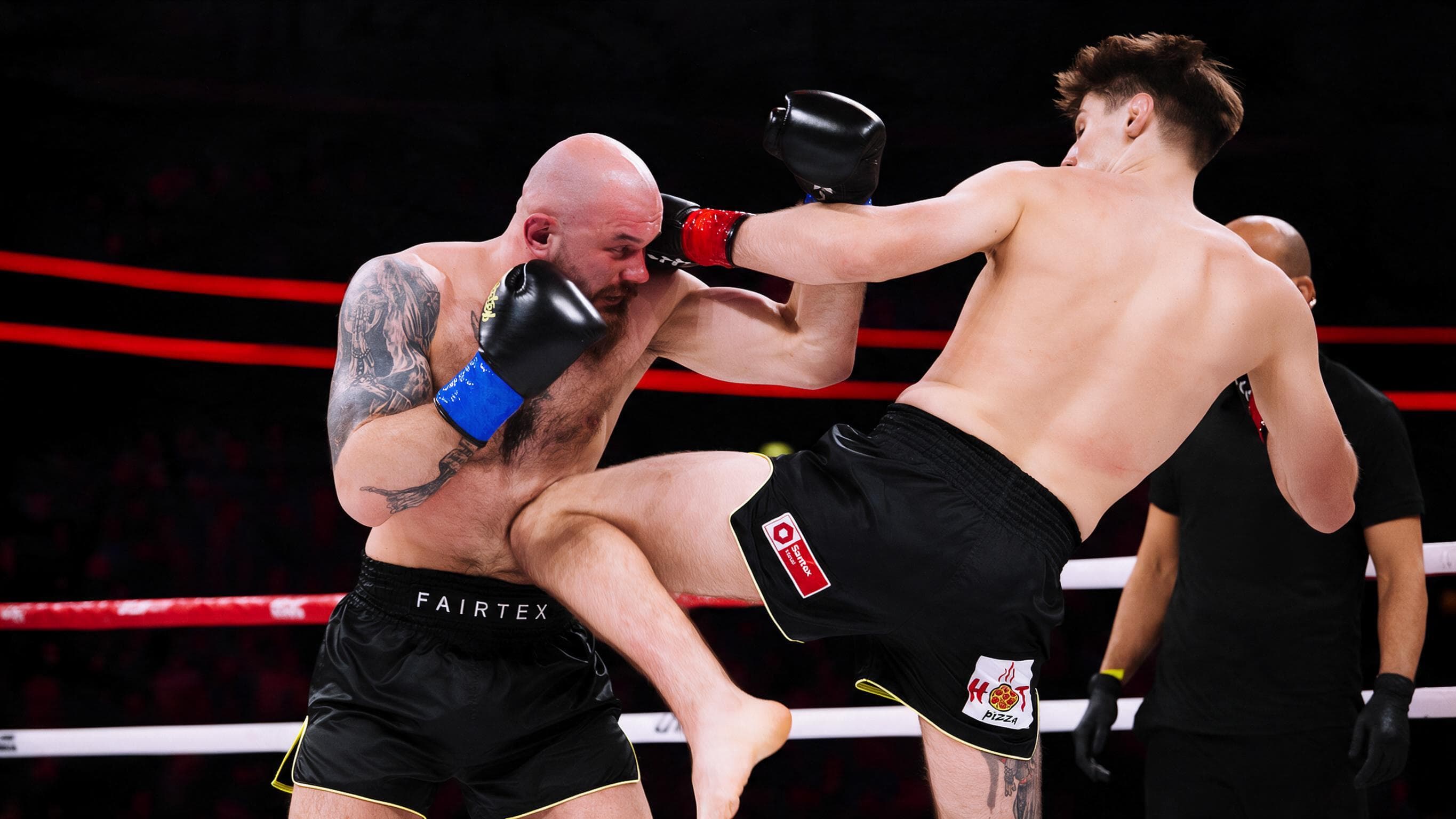
LukasKickboxing is a family of stand-up combat sports in which athletes use legal punches and kicks to defeat an opponent by knockout, technical knockout, judges' decision, or another result allowed by the event's rules. Some rulesets also permit knees and limited clinching. Elbows, extended clinches, throws, and takedowns are usually restricted or prohibited in modern professional kickboxing.
The word kickboxing does not describe one universal rulebook. A GLORY title fight, a K-1 tournament bout, a ONE Championship kickboxing match, and a WAKO full-contact contest can all be kickboxing while differing in legal techniques, protective equipment, round structure, weight classes, and judging details.
That distinction matters whenever you watch a fight, compare records, or decide whether a bout belongs in a professional kickboxing database.
Is kickboxing a martial art or a sport?
It is both.
Kickboxing is a martial art because it teaches a system of striking, defense, movement, distance control, and physical preparation. It is also a combat sport because those skills are tested in regulated competition with defined rounds, weight divisions, officials, fouls, and methods of victory.
The competitive sport includes several related disciplines rather than one fixed format. The World Association of Kickboxing Organizations recognizes point fighting, light contact, kick light, full contact, low kick, and K1 Style among its kickboxing disciplines. WAKO separates controlled-contact tatami disciplines from full-power ring disciplines.
Professional organizations normally use full-contact ring rules. Their exact regulations still vary, which is why “kickboxing rules” should always be followed by a second question: whose rules?
What are the basic rules of kickboxing?
Most professional kickboxing fights share a common foundation:
- Two fighters compete standing in the same weight division or at an agreed catchweight.
- Punches and kicks to legal target areas are allowed.
- Knees may be allowed, depending on the ruleset.
- Elbows are normally prohibited in kickboxing.
- Takedowns and prolonged ground fighting are prohibited.
- Clinching is either prohibited or limited to immediate offensive action.
- A referee enforces the rules and can issue cautions, deductions, counts, or stoppages.
- If no stoppage occurs, judges score the fight under the applicable system.
This framework distinguishes kickboxing from boxing, which does not permit kicks, and from mixed martial arts, which includes takedowns and ground fighting. It also separates most kickboxing formats from Muay Thai, where elbows and a much broader clinch game are central weapons.
Which techniques are legal?
| Technique | Common professional kickboxing treatment |
|---|---|
| Straight punches, hooks and uppercuts | Legal to permitted target areas |
| Kicks to the head and body | Legal |
| Low kicks to the thigh | Legal in K-1-style and most major professional rules; not universal across every kickboxing discipline |
| Knee strikes | Commonly legal in K-1-style, GLORY and ONE kickboxing, subject to clinch restrictions |
| Elbow strikes | Usually illegal |
| Extended clinching | Usually prohibited or strictly limited |
| Sweeps and throws | Usually illegal or narrowly restricted |
| Takedowns and ground fighting | Illegal |
| Strikes to the groin, back of the head or after the break | Illegal |
GLORY's official rules provide a current example of a professional ruleset. The organization permits punches, kicks, and knees but prohibits elbows and limits clinch action. Its 2025 clarification allows one immediate strike from a clinch before the athletes must disengage.
ONE Championship also distinguishes its two striking sports explicitly. Under ONE's Global Kickboxing Rule Set, a knockout can come from a punch, kick, or knee. Under its Muay Thai rules, elbows and legal throws are also included.
Pro Tip: Never decide whether a technique was legal by comparing it with another promotion. Check the rules attached to that particular bout.
What are the main styles of kickboxing?
“Style” can refer either to a competition ruleset or to the technical background a fighter brings into it. A karate-based fighter and a Muay Thai specialist can meet under the same kickboxing rules while using very different movement, timing, and combinations.
The main competitive formats include:
| Format | Defining features |
|---|---|
| Full contact | Full-power punches and kicks, traditionally with kicks restricted above the waist in some rulebooks |
| Low kick | Adds legal kicks to the thighs to the full-contact framework |
| K-1 style | Punches, kicks, low kicks, and knees with restricted clinching and no elbows |
| Point fighting | Stop-start or controlled-contact competition based on clear scoring techniques |
| Light contact / kick light | Continuous but controlled-contact formats, with the permitted targets depending on the discipline |
| Professional promotion rules | Organization-specific regulations used by GLORY, ONE, K-1, RISE, and other promoters |
K-1 style has become one of the most recognizable international formats. It favors continuous stand-up action, allows low kicks and knees, and prevents athletes from turning the contest into extended wrestling or clinch fighting.
“Dutch kickboxing” normally describes a training and fighting approach rather than a separate universal rulebook. It is associated with boxing combinations, low kicks, pressure, and combination finishing. A Dutch-style athlete still competes under the rules selected by the promoter.
How many rounds are in a kickboxing fight?
Many professional kickboxing bouts consist of three three-minute rounds with one-minute breaks. Championship fights are often five three-minute rounds.
ONE uses three three-minute rounds for standard kickboxing contests and five for World Championship bouts. GLORY also commonly uses three-round contests and five-round title fights. Tournament bouts can use additional provisions because a winner must advance on the same night.
The number of rounds is not universal. Amateur divisions, developmental bouts, tournaments, age categories, and local regulations can use different durations. The event page and official rulebook should take priority over a general description.
How are kickboxing fights scored?
Most major professional organizations use a round-by-round 10-point-must system. The fighter who wins a round normally receives 10 points, while the opponent receives 9 or fewer. Knockdowns, damage, clean legal strikes, dominance, and point deductions can widen or change the score.
Judges do not simply award one point for every visible strike. Effective legal offense matters more than activity that misses, lands on the guard without effect, or violates the rules.
The exact hierarchy varies. GLORY's current criteria prioritize knockdowns, high-impact damage, other damage, clean strikes, and then effective aggression or ring domination. ONE lists knockdowns, damage, clean strikes, and aggression or ring generalship for kickboxing decisions.
For a full round-by-round explanation, read How Kickboxing Scoring Works: 10-Point Must, Knockdowns and Decisions.
How can a kickboxing fight end?
| Result | What it generally means |
|---|---|
| KO | A fighter cannot continue after a legal knockdown and count, or the referee stops the contest immediately for safety |
| TKO | The referee, doctor, corner, or a promotion-specific knockdown rule stops the fight |
| Unanimous decision | Every judge selects the same winner |
| Split decision | A majority selects one fighter while another judge selects the opponent |
| Majority decision | A majority selects one fighter while another judge scores a draw |
| Draw | The scorecards do not produce a winner under the applicable rules |
| Disqualification | A fighter loses because of a serious or repeated rules violation |
| No contest | The bout ends without a valid winner under the rulebook |
Some tournament or title-eliminator formats add an extension round when the scheduled rounds are tied. Other contests permit a draw. Again, the event's rules control the result.
What equipment do kickboxers use?
Professional fighters commonly wear boxing gloves, a mouthguard, groin protection, shorts, and approved hand wraps. Female athletes may use additional required protection. Professional contests normally do not use headgear or shin guards.
Amateur equipment varies by discipline and governing body. Some formats require head protection, shin guards, foot protection, or different glove specifications. That equipment does not by itself prove whether a historical bout was amateur or professional; its official classification remains the better evidence.
Promotion differences can be substantial. ONE currently specifies 8-ounce boxing gloves for kickboxing athletes at bantamweight or lighter and 10-ounce gloves at featherweight or heavier, while its Muay Thai contests use 4-ounce mixed martial arts gloves. Those are ONE rules, not a universal standard for the entire sport.
What is the difference between kickboxing and Muay Thai?
Kickboxing and Muay Thai are related stand-up combat sports, but they are not interchangeable labels.
Muay Thai is known as the “art of eight limbs” because punches, kicks, knees, and elbows are all central weapons. It also permits sustained clinch work and legal off-balancing or throws within its rules. Modern K-1-style kickboxing normally permits punches, kicks, and knees but prohibits elbows, limits the clinch, and does not allow Muay Thai-style extended grappling.
Those differences change distance, defense, combinations, scoring, and the rhythm of a fight. They also change the record. A professional Muay Thai bout should not silently increase a fighter's professional kickboxing W-L total.
Read Kickboxing vs Muay Thai: Rules, Scoring and Key Differences for the full comparison.
Is kickboxing the same as K-1?
No. Kickboxing is the broader sport. K-1 is both the name of a promotion and a widely recognized rules format influenced by the competition it popularized.
People often use “K-1 rules” as shorthand for full-contact kickboxing that allows punches, kicks, low kicks, and knees while prohibiting elbows and restricting clinching. But promoters can adopt different versions, and an event advertised as K-1 style is not necessarily promoted by K-1 itself.
This is why a database should store the promotion, discipline, and rules context separately instead of treating “K-1,” “kickboxing,” and “Muay Thai” as synonyms.
How are professional kickboxing records calculated?
A professional record should be derived from the individual bouts documented for that fighter. Each win, loss, draw, or no contest should connect to an opponent, event, date, rules classification, and published outcome.
KickboxHub does not manually increase a fighter's headline W-L total to match an unsupported biography or promotional graphic. The displayed total is calculated from documented professional bouts currently present in the database.
That means a KickboxHub record can be accurate within its documented scope without claiming that every professional bout in the athlete's career has already been found. Some organizations do not publish complete historical results.
For the classification problem in detail, read Why Kickboxing Records Disagree: Pro vs Amateur Fights.
How should a new fan follow professional kickboxing?
Start with four pieces of context:
- Identify the ruleset. Confirm whether the contest is kickboxing, Muay Thai, boxing, or another discipline.
- Check the weight division. Weight-class names and limits differ between organizations.
- Read the complete fight card. A main event is only one part of an event's competitive history.
- Follow the result method. KO, TKO, UD, SD, MD, DQ, and NC tell different stories.
KickboxHub connects those elements through fighter histories, event pages, promotion archives, and bout-level results. Browse upcoming events, inspect past results, or search the fighter database.
Common misconceptions about kickboxing
“Kickboxing is one fixed ruleset”
It is an umbrella term. Full contact, low kick, K-1 style, amateur disciplines, and professional promotion rules differ.
“All kickboxing allows elbows”
Most major modern professional kickboxing rules prohibit elbows. Elbows are a defining weapon in Muay Thai.
“Every kickboxing fight has three rounds”
Three three-minute rounds are common, but title fights, tournaments, amateur categories, and local regulations can differ.
“The busier fighter always wins”
Not necessarily. Judges evaluate effective legal offense, knockdowns, damage, clean strikes, and the priorities of the particular rulebook.
“A fighter's advertised record is automatically a kickboxing record”
It may combine amateur, Muay Thai, boxing, exhibition, or undocumented results. A discipline-specific record needs bout-level classification.
Key takeaways
| Question | Short answer |
|---|---|
| What is kickboxing? | A family of regulated stand-up combat sports centered on punches and kicks |
| Is it a martial art? | Yes; it is both a martial art and a competitive combat sport |
| Are knees allowed? | Often under K-1-style and major professional rules, but check the event |
| Are elbows allowed? | Usually not in kickboxing |
| Is clinching allowed? | Normally prohibited or tightly limited |
| How are fights scored? | Commonly round by round under a 10-point-must system |
| How long is a fight? | Often three three-minute rounds; many title fights use five |
| Is Muay Thai kickboxing? | It is a related but distinct combat sport and ruleset |
Kickboxing is easiest to understand when the name of the sport is treated as the beginning of the explanation, not the end. The promotion and ruleset determine which techniques are legal, how judges score the action, and which result belongs in the fighter's record.
— Lukas
Explore professional kickboxing records and results
Use the KickboxHub fighter database to inspect documented professional records, browse events for schedules and results, and open the promotions directory to follow organization-specific histories.
For deeper explanations, continue with the guides to kickboxing scoring, weight divisions, and professional versus amateur records.
FAQ
What is kickboxing in simple terms?
Kickboxing is a stand-up combat sport in which fighters use legal punches and kicks. Depending on the ruleset, knees and limited clinching may also be allowed. Fighters win by stoppage, judges' decision, disqualification, or another official result.
Is kickboxing a martial art?
Yes. Kickboxing is a martial art built around striking, defense, movement, and conditioning, and it is also a regulated competitive combat sport.
Are elbows allowed in kickboxing?
Elbows are normally prohibited in major professional kickboxing rulesets such as GLORY and ONE kickboxing. They are permitted in Muay Thai, which is one of the clearest differences between the sports.
Can kickboxers use knees?
Knees are legal in many K-1-style and professional rulesets, but the amount of clinching allowed to deliver them is restricted. Other kickboxing disciplines may use different rules.
Does kickboxing include takedowns or ground fighting?
No. Modern kickboxing is a stand-up sport. Takedowns, submissions, and continued ground fighting belong to other rulesets such as mixed martial arts.
How many rounds are in professional kickboxing?
Three three-minute rounds are common for standard professional bouts, while many championship fights use five three-minute rounds. Tournament and regional rules can differ.
What is K-1-style kickboxing?
K-1 style generally permits punches, kicks, low kicks, and knees while prohibiting elbows, takedowns, and prolonged clinching. The exact version depends on the organizer's published rules.
Recommended

Comments (0)
Sign in to leave a comment.
No comments yet. Be the first!