
How Kickboxing Scoring Works: 10-Point Must, Knockdowns, Decisions
 Lukas
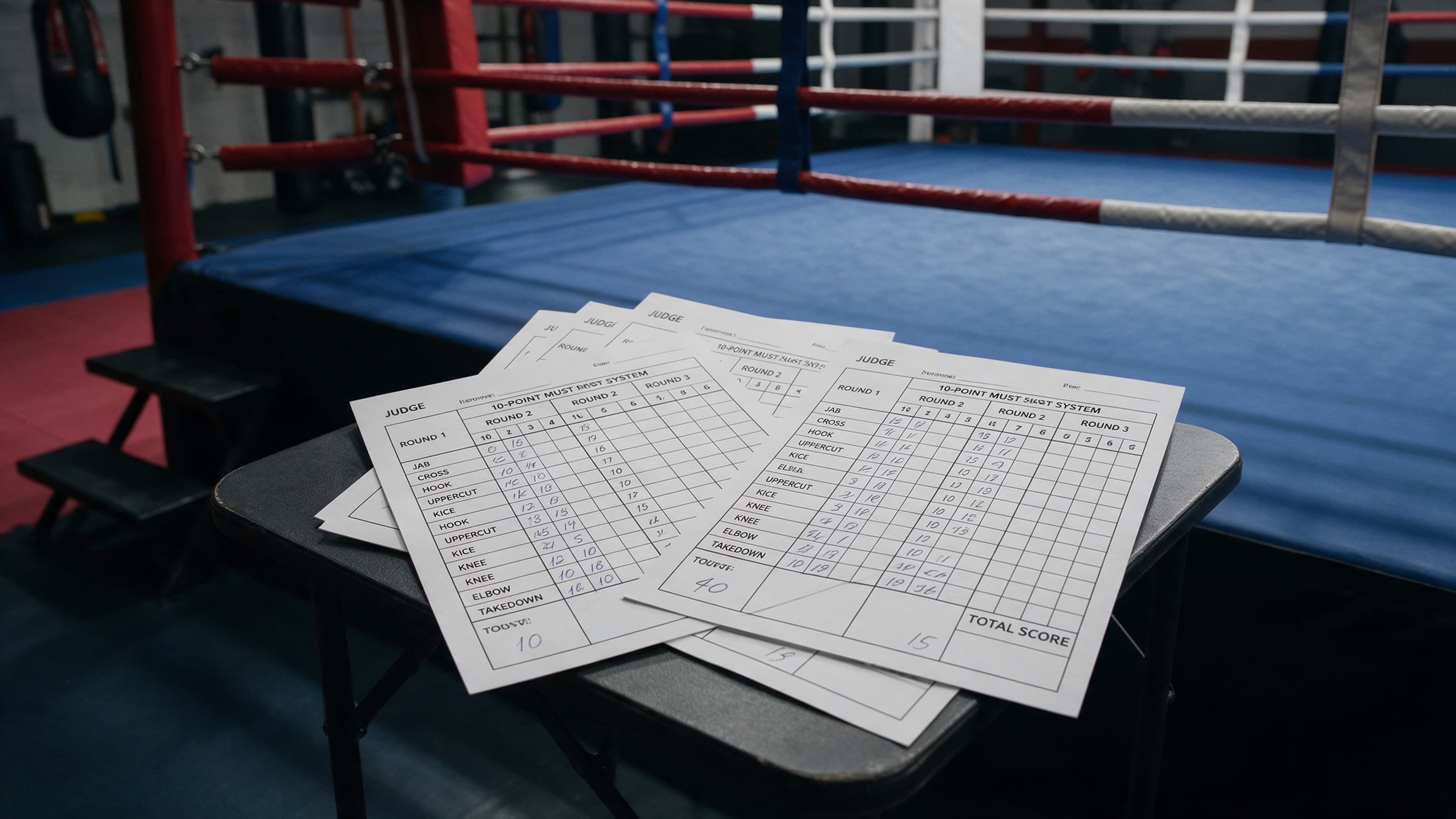
LukasKickboxing scoring usually uses a round-by-round 10-point-must system. The winner of a round normally receives 10 points, while the other fighter receives 9 or fewer depending on knockdowns, damage, dominance, and penalties. Judges score independently, then their totals determine a unanimous, split, majority, or draw result if the fight reaches the final bell.
That simple explanation hides an important detail: kickboxing does not have one universal rulebook. GLORY, ONE Championship, K-1, RISE, WAKO, and regional regulators can prioritize criteria differently. A fan who understands the scoring system must know both the general framework and the promotion-specific rules being used on that night.
How does the 10-point-must system work in kickboxing?
Under the 10-point-must system, at least one fighter normally receives 10 points in each completed round before deductions. The fighter judged to have lost the round usually receives 9. A knockdown, severe damage, overwhelming dominance, or a point deduction can lower that score further.
The three most familiar scores are:
| Round score | General meaning |
|---|---|
| 10-9 | One fighter won the round without the separation required for a wider score |
| 10-8 | A clear knockdown or a strongly dominant, damaging round under the applicable rules |
| 10-7 | Multiple knockdowns or exceptional dominance where the rulebook permits it |
The precise trigger is promotion-specific. Under GLORY's official 2026 rules, one knockdown normally results in a 10-8 round, although a 10-9 is possible in the rare case that the knocked-down fighter otherwise produced a significantly dominant performance. Two knockdowns normally produce a 10-7, but the guidelines allow a 10-8 when other scoring factors weigh heavily for the opponent. The same document permits a 10-10 when no marginal advantage can be determined, even though judges are generally expected to separate the fighters when the evidence supports it.
After the round, each judge records a score independently. The points are added across the scheduled rounds, minus any deductions. A judge's completed card represents that judge's decision for the entire fight.
A basic three-round example
| Round | Fighter A | Fighter B | Why |
|---|---|---|---|
| Round 1 | 10 | 9 | Fighter A lands the more effective offense |
| Round 2 | 9 | 10 | Fighter B clearly wins the round |
| Round 3 | 10 | 9 | Fighter A wins the final round |
| Total | 29 | 28 | Judge awards the fight to Fighter A |
If all judges submit a 29-28 card for Fighter A, the official result is a unanimous decision. If two judges select Fighter A and the third selects Fighter B, it is normally a split decision.
Pro Tip: Do not judge a close fight by the total number of highlights. Score each round separately using the promotion's prioritized criteria, then add the rounds at the end.
What do kickboxing judges look for when scoring a round?
Judges do not simply count every punch and kick as one equal point. Effective offense matters more than empty activity. A clean strike that causes visible damage can outweigh several light or partially blocked techniques, especially under a rulebook that explicitly prioritizes damage.
GLORY's 2026 criteria are ordered as follows:
- Knockdowns. A fighter who scores one or more knockdowns wins the round unless deductions change the result.
- Damage. High-impact damage—such as wobbling, staggering, or reduced functionality from a legal strike—is prioritized over other damage.
- Number of clean strikes. Clean legal techniques count; spectacular flying and spinning techniques receive additional priority in GLORY's framework.
- Aggressiveness or ring domination. Attacks are prioritized over defense when earlier criteria do not settle the round.
GLORY also uses open scoring, meaning the judges' scores are publicly available after each round.
ONE Championship uses a similar but separately stated hierarchy for kickboxing decisions: knockdowns, damage, number of clean strikes, and aggression or ring generalship. ONE also uses three judges scoring round by round under the 10-point-must system. See ONE Championship's official martial arts rules.
| Scoring factor | What judges are evaluating | What does not automatically score |
|---|---|---|
| Knockdowns | Legal attacks that force a count or meet the rulebook's down definition | Slips, trips, and off-balance falls |
| Damage | Visible or functional effect caused by legal techniques | Dramatic reactions caused by blocked or illegal strikes |
| Clean strikes | Legal punches, kicks, and knees landing effectively on valid targets | Missed, blocked, or illegal techniques |
| Aggression | Effective forward pressure that creates scoring offense | Walking forward while being countered cleanly |
| Ring control | Dictating range, position, pace, and exchanges | Movement that produces no effective offense |
This is why two fighters can land a similar number of techniques and still lose the round clearly. Impact, legality, defensive reaction, and control of the exchange determine the value of those strikes.
Do punches, kicks, and knees score the same?
There is rarely a universal “one point per strike” calculation in professional kickboxing. Legal punches, kicks, and knees can all score, but their value depends on effectiveness rather than the body part used.
GLORY requires a scoring technique to be thrown with full power, from the correct distance and body position, and to land on a legal target. Its legal scoring techniques include punches, a wide range of kicks, and knees. The rulebook then evaluates the effect of the offense through the prioritized criteria rather than assigning a fixed numerical value to every technique.
A clean jab that disrupts balance can matter more than three low kicks that are checked. A body kick that visibly compromises breathing or movement can matter more than a fast combination absorbed mostly by the gloves. A spectacular technique does not win a round merely because it looked difficult; it must land legally and effectively.
Common judging mistakes made by viewers include:
- Counting glove contact as a clean punch.
- Treating every forward step as effective aggression.
- Awarding a round for the final exchange while ignoring the first two minutes.
- Giving extra credit for crowd reaction rather than the strike's actual effect.
- Counting illegal clinch work, catches, sweeps, or elbows under a ruleset that prohibits them.
- Assuming a high-volume fighter automatically beat a lower-volume fighter who landed the more damaging shots.
How do knockdowns affect kickboxing scoring?
Knockdowns are normally the highest-priority scoring event in a round. They create clear separation because they show that a legal attack produced an immediate and serious effect.
Under GLORY's current rules, a fighter can be considered down when a damaging attack causes part of the body other than the feet to touch the floor, when the ropes prevent that fall, or when the referee judges that the athlete is in a weakened and potentially unsafe state while still standing. The referee—not the judges or broadcast team—decides whether the sequence is officially a knockdown.
Once the referee calls a down, the scoring implications can be substantial:
| Round event under current GLORY rules | Illustrative score |
|---|---|
| One fighter wins the round without a knockdown | 10-9 |
| One knockdown | Normally 10-8; 10-9 is possible in rare circumstances |
| High-intensity damage plus significant dominance | 10-8 |
| Two knockdowns by the same fighter | Normally 10-7; 10-8 is possible when other factors weigh heavily for the opponent |
| Knockdown plus a deduction against the scoring fighter | Apply the deduction before finalizing the card |
These examples should not be applied blindly to every promotion. Knockdown limits, standing counts, tournament stoppage rules, and required round scores can differ. ONE Championship, for example, lists three knockdowns in one round or four across a bout as a TKO condition under its global kickboxing rules.
Pro Tip: When reviewing a disputed score, first confirm whether the referee officially ruled a knockdown. A replay that looks like a knockdown does not change the scorecard if the referee ruled it a slip—and the proper protest process belongs to the event's regulator.
How do warnings and point deductions change the score?
The referee controls fouls and deductions. Judges score the round's action, then apply the official deduction communicated by the referee.
Under the current GLORY framework, consequences can progress from a caution to an official warning, a penalty point, and ultimately disqualification depending on the nature, severity, intent, and repetition of the foul. Examples of prohibited conduct include elbows, attacks to illegal target areas, certain clinching or holding, throws, striking after “break” or “stop,” and repeated stalling.
Imagine Fighter A wins a round 10-9 but loses one point for a foul. That judge's finalized round can become 9-9. If Fighter A was already losing the round 9-10 and receives a one-point deduction, the finalized score can become 8-10.
Point deductions can therefore convert a winning round into an even round or turn a close decision into a loss. They are not a separate popularity penalty added after the fight; they are part of the mathematical score.
What is the difference between unanimous, split, and majority decisions?
The decision label describes how the judges' completed cards relate to one another. It does not describe how exciting or dominant the fight looked.
| Result | Typical three-judge configuration |
|---|---|
| Unanimous decision (UD) | All three judges select the same winner |
| Split decision (SD) | Two judges select one fighter; one judge selects the opponent |
| Majority decision (MD) | Two judges select one fighter; one judge scores a draw |
| Unanimous draw | All three judges score the fight a draw |
| Majority draw | Two judges score a draw; one selects a fighter |
| Split draw | The cards are divided between each fighter and a draw |
A split decision does not automatically mean the result was wrong. It means the judges disagreed about who won under their independent round-by-round assessments. Likewise, a unanimous decision can contain three close 29-28 scorecards. “Unanimous” describes agreement, not necessarily dominance.
For record databases, the distinction matters. UD, SD, and MD are all decision wins, but they describe different scorecard patterns. Preserving the exact method makes the fight history more useful than recording every decision simply as “DEC.”
What do KO, TKO, technical decision, DQ, and no contest mean?
Not every kickboxing result comes from the judges' final totals.
| Method | General meaning |
|---|---|
| KO | A fighter cannot resume before the referee completes the required count, or the referee immediately declares a knockout for safety |
| TKO | The referee, doctor, corner, or promotion-specific knockdown rule stops the fight without a completed decision |
| Technical decision | A fight is stopped after the minimum required duration and completed scorecards determine the result under the rules |
| DQ | A fighter loses because of a disqualifying foul or rule violation |
| Draw | Neither fighter is declared the winner after the applicable scorecard and extra-round rules |
| No contest (NC) | The bout ends without a winner in circumstances defined by the rulebook, often involving an early accidental foul or another invalidating event |
The exact definitions and thresholds remain rulebook-specific. GLORY's 2026 rules distinguish KO, TKO, points decisions, disqualification, draws, and no contests, and explain when an accidental foul produces an NC rather than a scorecard decision. ONE separately lists knockout, technical knockout, decision, technical decision, disqualification, and athlete-requested stoppage among its possible kickboxing outcomes.
This is one reason fight databases should store the result method, round, time, and event context whenever those details are available. A “win” alone cannot tell the reader whether the fighter controlled three rounds, scored a ten-second knockout, advanced after a doctor stoppage, or received a technical decision.
What happens when a kickboxing fight is tied?
The answer depends on the bout type and promotion.
GLORY's current rules provide several examples:
- A drawn three-round match can receive one Sudden Victory round, and only that extra round determines the winner.
- A five-round title fight between a defending champion and challenger can remain a draw, with the defending champion retaining the title.
- A vacant-title fight, designated title eliminator, or qualifying five-round main event can receive an extra round if the scheduled rounds end tied.
- Tournament finals can receive up to two Sudden Victory rounds under the tournament provisions.
ONE states that if points are tied, judges use its ordered kickboxing criteria to determine the winner. Other promotions and regulators may permit draws, require an extra round, or use a different tiebreak process.
The lesson is simple: never assume “kickboxing has no draws” or “every draw gets an extra round.” Check the event's rules and whether the fight is a standard bout, title contest, eliminator, or tournament match.
How can fans score a kickboxing fight more accurately?
Use a repeatable process instead of scoring by instinct:
- Confirm the ruleset. Identify the promotion, scheduled rounds, legal techniques, and published scoring priorities.
- Score one round at a time. Do not let a dominant third round rewrite two earlier rounds.
- Record official knockdowns. Give them the priority required by the rulebook.
- Evaluate damage and clean offense. Separate landed techniques from blocks, misses, and illegal contact.
- Use aggression only when it is effective. Forward movement without scoring offense should not erase clean counters.
- Apply announced deductions. Do not invent penalties for behavior the referee only cautioned.
- Keep each judge's possible perspective separate. Angle and visibility can affect which legal strikes a ringside judge sees clearly.
An informal fan scorecard should look like this:
| Round | Red corner | Blue corner | Deciding evidence |
|---|---|---|---|
| 1 | 10 | 9 | Red landed the cleaner, more damaging combinations |
| 2 | 9 | 10 | Blue controlled range and landed repeated clean kicks |
| 3 | 8 | 10 | Blue scored an official knockdown and dominated the remaining exchanges |
| Total | 27 | 29 | Blue wins on this observer's card |
Writing one short reason per round prevents hindsight from silently changing the standard after the result is announced.
Common myths about kickboxing judging
“Every landed strike is worth one point”
Professional 10-point-must judging is not a simple touch counter. Effect, damage, knockdowns, clean technique, and promotion-specific priorities matter.
“The fighter moving forward is winning”
Forward movement is useful only when it produces effective offense or meaningful control. A fighter being countered cleanly while advancing may be losing the round.
“A split decision proves the judges made a mistake”
It proves that the independent scorecards differed. The decision may still be defensible under the rules, especially in a close fight with swing rounds.
“A unanimous decision means every round was dominant”
Three judges can all produce close 29-28 cards. Unanimity describes agreement on the winner, not the margin of each round.
“All promotions score kickboxing the same way”
They do not. The 10-point-must framework is widespread, but legal techniques, criteria order, knockdown treatment, extra rounds, open scoring, and regulator requirements can vary.
Key takeaways
Kickboxing scoring becomes much easier to understand once each round is evaluated through the event's actual rulebook rather than through crowd reaction or raw strike volume.
| Point | Details |
|---|---|
| Most major professional bouts use 10-point-must | The round winner normally receives 10; the opponent receives 9 or fewer before deductions. |
| Knockdowns usually carry first priority | An official knockdown creates strong scorecard separation and can trigger a wider round. |
| Effective offense beats empty activity | Damage and clean legal strikes matter more than blocked combinations or ineffective pressure. |
| Deductions change the mathematics | A foul can turn a won round into an even round or expand a losing score. |
| Decision labels describe judge agreement | UD, SD, and MD represent different combinations of completed scorecards. |
| Promotion rules still control | GLORY, ONE, K-1, RISE, WAKO, and regulators can use different priorities and tiebreak procedures. |
Why a result method matters as much as the W-L total
A scorecard is the explanation behind a decision result. Reducing every fight to a single W or L removes the difference between a dominant five-round unanimous decision, a disputed split decision, and a technical decision following an accidental foul.
That distinction matters when building a kickboxing database. A fighter's decision history can show consistency across full-distance fights. Repeated split decisions can identify bouts that deserve closer video and scorecard review. Knockdowns and point deductions can explain totals that otherwise look strange. The method, round, and time turn the record from a headline into a usable sporting history.
This is also why promotion-specific context must stay attached to the bout. A result recorded under GLORY rules should not be reinterpreted using ONE's tiebreak criteria or an amateur WAKO point system. The official result belongs to the rules that governed the contest.
Kickboxing judging will always contain human interpretation. Transparency cannot remove every close call, but it can make the result understandable: preserve the ruleset, the method, the scorecards when available, and the official event record.
— Lukas
Follow kickboxing results with the full fight context
KickboxHub connects professional kickboxing results to fighters, events, promotions, methods, rounds, and ranking changes.
Browse the fighter database to compare decision and stoppage histories, use past event results to inspect complete cards, and explore the promotions directory to understand which rules governed each bout. The KickboxHub ranking methodology explains how recorded results feed into activity-aware ratings.
The final letters—UD, SD, MD, KO, TKO, DQ, or NC—are short. The fight context behind them is what makes the record meaningful.
FAQ
How are points awarded in kickboxing?
Most major professional promotions use a 10-point-must system. The round winner normally receives 10 points, while the opponent receives 9 or fewer based on knockdowns, damage, dominance, and deductions under the applicable rulebook.
Does a knockdown always make a round 10-8?
No. It commonly creates a 10-8 round in professional kickboxing, but the applicable rules and the rest of the round still matter. Under GLORY's 2026 rules, one knockdown normally produces a 10-8, although a 10-9 is possible in rare circumstances; two knockdowns normally produce a 10-7, with 10-8 possible when other factors weigh heavily for the opponent.
What is the difference between a split and majority decision?
With three judges, a split decision normally means two judges selected one fighter and the third selected the opponent. A majority decision normally means two judges selected one fighter while the third scored the bout a draw.
Do blocked punches and kicks score in kickboxing?
Blocked or missed techniques generally do not carry the value of clean legal strikes. Judges evaluate effective offense, including the quality, damage, and visible effect of techniques that reach legal targets.
Can a kickboxing fight end in a draw?
Yes, depending on the promotion and bout type. Some drawn bouts remain draws, while others proceed to an extra or Sudden Victory round. Title fights and tournament matches can use different tiebreak procedures.
Are GLORY and ONE Championship scoring rules identical?
No. Both use round-by-round 10-point-must scoring and prioritize knockdowns, damage, clean strikes, and aggression, but their exact rules, officials, knockdown provisions, tiebreak procedures, and event regulations are independently defined.
Recommended

Comments (0)
Sign in to leave a comment.
No comments yet. Be the first!