

Kickboxing Weight Divisions Explained: The K-1 Guide
 Lukas
LukasKickboxing weight divisions are formalized upper weight limits set at the official weigh-in to create fair, structurally matched bouts and protect fighters from dangerous physical mismatches. Understanding kickboxing weight divisions explained through the K-1 framework means grasping eight distinct classes, from featherweight at 65 kg up to heavyweight near 100 kg, each carrying its own tactical identity and physiological demands. This guide covers the full spectrum of K-1 weight categories, the science of weight cutting and rehydration, the real cost of jumping divisions, and a punch-impact case study that every serious competitor should read before making a career-defining move.
What are the traditional K-1 kickboxing weight divisions?
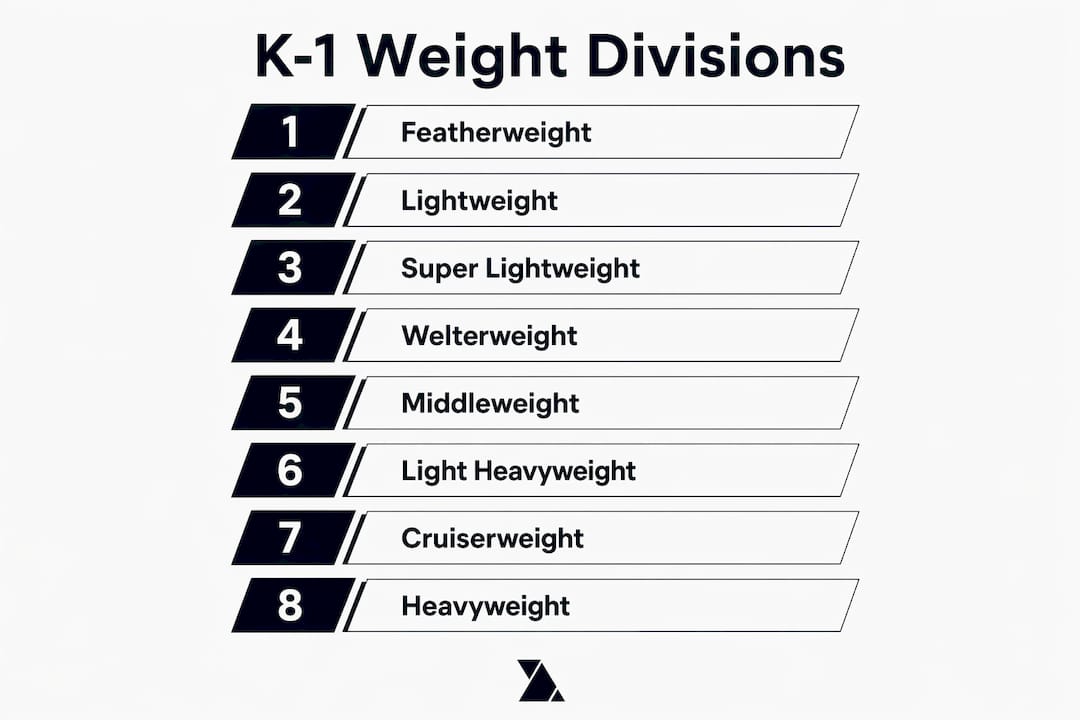
K-1 weight divisions start at featherweight and extend incrementally to heavyweight, with each class defined by a strict upper weight limit enforced at the official weigh-in. The structure reflects both tactical and safety considerations baked into the K-1 ruleset. Weight divisions fundamentally exist to prevent dangerous mismatches that could cause severe physical trauma, not simply to organize brackets.
| Division | Upper Limit (kg) | Upper Limit (lbs) |
|---|---|---|
| Featherweight | 65 kg | 143 lbs |
| Lightweight | 70 kg | 154 lbs |
| Super Lightweight | 75 kg | 165 lbs |
| Welterweight | 80 kg | 176 lbs |
| Middleweight | 85 kg | 187 lbs |
| Super Middleweight | 90 kg | 198 lbs |
| Light Heavyweight | 95 kg | 209 lbs |
| Heavyweight | 100+ kg | 220+ lbs |

The weigh-in occurs 24 hours before the fight, giving fighters a recovery window to rehydrate and restore muscle glycogen before competing. Failure to make weight triggers consequences ranging from renegotiated catchweight bouts to full fight cancellations. In championship contexts, missing weight can mean title forfeiture and financial penalties that reshape a fighter's entire career trajectory.
It is also worth noting that weight class limits vary significantly across promotions. The "Middleweight" label alone spans 72.5 kg in some organizations to 85 kg in K-1, a 12.5 kg gap that would put two fighters labeled the same division in completely different physical categories. K-1, RISE, and ONE Championship each operate with their own division structures, which creates real complexity for fighters competing across multiple organizations.
Pro Tip: Before signing a contract with any promotion, verify the exact weight limit for your division in that specific organization's rulebook. Assuming K-1 limits apply universally is a mistake that has derailed more than one fighter's preparation cycle.
How do fighters use weight cutting to gain a competitive edge?
Weight cutting is the deliberate process of reducing body mass before a weigh-in, then rehydrating aggressively before the fight, with the goal of competing as the largest, most powerful athlete in a given division. The tactical logic is straightforward: walk into the cage at 90 kg after making weight at 85 kg, and you carry a structural size advantage over opponents who compete at their natural weight. Fighters frequently cut upwards of 25 lbs during fight week, a figure that signals just how normalized extreme dehydration has become in combat sports.
The physiological cost is real and measurable. Rapid dehydration impairs organ function, reduces blood plasma volume, and compromises cardiovascular output. Rehydration in the 24-hour window restores some of this, but blood volume and electrolyte balance do not fully normalize overnight. The result is a fighter who may look recovered but carries hidden deficits in endurance and cognitive sharpness by the third round.
The most effective weight management approach follows a graduated protocol rather than a crisis-mode cut. The World Boxing Council advocates multi-stage weight monitoring with check-ins 30, 14, and 7 days out from fight night, a model that reduces acute weight swings and preserves long-term fighter health. Gradual weight management approaches are gaining traction across combat sports precisely because the data on extreme cuts keeps pointing in the same direction: short-term gain, long-term damage.
Here are the weight cutting best practices and common pitfalls every competitor should know:
- Start the cut early. Begin reducing caloric intake and water weight 6 to 8 weeks out, not 5 days before the weigh-in.
- Monitor electrolytes throughout. Sodium, potassium, and magnesium depletion accelerates fatigue and increases cramp risk during the fight.
- Use a sports dietitian. Unguided cuts based on gym folklore produce inconsistent results and avoidable health crises.
- Rehydrate with structure. Oral rehydration solutions outperform plain water for restoring plasma volume in compressed timeframes.
- Avoid saunas in the final 12 hours. Late-stage thermal dehydration pushes core temperature up and recovery capacity down.
"The fighter who walks in rested and sharp at 83 kg will almost always outperform the fighter who walked in depleted at 85 kg and spent the night trying to recover."
Pro Tip: Track your natural walking weight across a full training camp. If the gap between your walking weight and your division limit exceeds 8 to 10 percent of body weight, you are likely in the wrong division.
What physiological challenges come with jumping weight classes?
Moving between kickboxing weight categories is not simply a matter of eating more or less. The physiological demands of each division differ in ways that affect stamina, power output, punch absorption, and injury risk in ways that are not always visible until the fighter is already in trouble.
Key physiological realities of changing weight classes include:
- Muscle mass and power output. Moving up a division typically requires adding lean mass, which takes months of structured hypertrophy training. Fighters who move up without adding genuine muscle simply become the smallest person in the new division.
- Cardiovascular load. A heavier body demands more from the cardiovascular system at the same work rate. Fighters moving up often find their gas tank depleted faster in the later rounds, particularly in K-1's three-round format.
- Punch absorption capacity. Larger fighters generate more force per strike, and the ability to absorb that force is partly structural. Bone density, neck musculature, and core stability all contribute, and none of these adapt quickly.
- Metabolic rate and recovery. Fighters who drop a division through severe caloric restriction often compromise their recovery capacity between training sessions, arriving at fight week already in a degraded state.
- Cognitive performance under fatigue. Rapid weight fluctuations alter blood volume and electrolyte levels, which compromises decision-making and reaction time precisely when the fight demands the most from the brain.
The science consistently shows that the fighters who thrive across multiple divisions are those who move with their natural body, not against it. Competing at a weight that requires extreme manipulation to reach is a structural ask that compounds over a career.
What happens when a middleweight champion challenges a natural light heavyweight?
The jump from middleweight at 85 kg to light heavyweight at 95 kg is one of the most structurally demanding transitions in kickboxing. It is not just 10 kg. It is a fundamentally different kinetic environment, and the punch-impact dynamics change in ways that can end careers.
Force equals mass multiplied by acceleration. A natural light heavyweight, walking at 97 to 100 kg and competing at 95 kg, generates meaningfully more momentum per strike than a middleweight who has rehydrated to 90 kg. Punch-impact dynamics change significantly with mass differences, and the effect is non-linear due to biomechanical factors including leverage, hip rotation speed, and skeletal frame size. The middleweight champion absorbing those shots faces a structural deficit that technique alone cannot fully compensate for.
| Factor | Middleweight (85 kg) | Light Heavyweight (95 kg) |
|---|---|---|
| Natural walking weight | ~88 to 92 kg | ~97 to 102 kg |
| Punch force (relative) | Baseline | 15 to 20% higher |
| Frame and reach | Compact | Extended |
| Rehydration advantage | Moderate | High |
| Injury risk (moving up) | Elevated | Baseline |
Case analysis confirms that middleweight champions face a measurable punch-impact disadvantage against natural light heavyweights, with increased kinetic energy and force transmission producing a decline in defensive resilience. You can see this pattern play out across the KickboxHub fighter database. Reviewing the Miloš Cvjetićanin kickboxing record illustrates how a dominant force at light heavyweight operates against opponents who lack the frame to absorb his output. Similarly, the Chico Kwasi fighter profile shows the physical profile of a fighter built for his division, not squeezed into it.
"The middleweight who moves up to challenge a natural light heavyweight is not just fighting a bigger man. He is fighting physics."
The strategic calculus for any team contemplating this move must account for more than the title opportunity. It must account for the cumulative neurological toll of absorbing heavier shots across multiple rounds, the recovery deficit that follows, and the long-term impact on the fighter's ability to perform at any weight.
How do weight division variances affect global kickboxing matchmaking?
The absence of universal weight class standards across kickboxing promotions creates a matchmaking environment where the same fighter can be a middleweight in one organization and a welterweight in another. Weight class limits vary widely across K-1, RISE, and ONE Championship, and this inconsistency has direct consequences for title eligibility, fight contracts, and career planning.
Key structural impacts on the global kickboxing landscape include:
- Title eligibility conflicts. A fighter holding a belt in one promotion may not qualify for the equivalent division in another organization due to differing weight limits.
- Matchmaking asymmetry. Cross-promotional superfights often require catchweight agreements precisely because the two organizations define the division differently.
- Career planning complexity. Fighters and their teams must map their optimal competition weight against the specific limits of each target promotion before committing to a division.
- Fan and media confusion. Inconsistent labeling makes it harder for audiences to contextualize records and rankings across organizations.
Staying current on these variances is a genuine competitive advantage. Monitoring the current kickboxing weight class rankings across promotions gives fighters and coaches a real-time picture of who is competing where and at what weight. Tracking the global kickboxing events schedule reveals which promotions are active in specific divisions and when title opportunities are likely to emerge. The fighters who treat this information as operational data, not background noise, make smarter decisions about when and where to compete.
Key takeaways
Kickboxing weight divisions are the structural backbone of fair competition, and mastering them requires understanding not just the numbers but the physiological and tactical realities behind every limit.
| Point | Details |
|---|---|
| K-1 division structure | Eight classes from featherweight at 65 kg to heavyweight above 100 kg define the competitive framework. |
| Weigh-in consequences | Missing weight in a championship bout can trigger title forfeiture, financial penalties, and fight cancellation. |
| Weight cutting risks | Cuts exceeding 8 to 10 percent of body weight compromise cardiovascular output, cognition, and recovery. |
| Middleweight to light heavyweight risk | Natural light heavyweights generate 15 to 20 percent more punch force, creating a measurable structural disadvantage for movers-up. |
| Promotion variance | "Middleweight" spans 72.5 kg to 85 kg across global promotions, requiring fighters to verify limits per organization. |
Why weight division strategy is the most underrated skill in kickboxing
By Lukas
I have watched more fighters derail their careers through poor division strategy than through any technical deficiency in the gym. The weight cut conversation in combat sports tends to fixate on the dramatic, the 25-pound fight-week plunge, the fighter who collapses at the weigh-in. What gets less attention is the slow erosion: the fighter who spends three years competing five kilograms below his natural weight, arriving at every camp already depleted, wondering why his chin is getting worse and his gas tank keeps shrinking.
The fighters I have seen thrive long-term are those who treat their division as a strategic asset, not a fixed identity. They move when the data supports it, not when a promoter dangles a bigger payday. They understand that competing at 85 kg when your body wants to be at 88 kg is a tax you pay on every training session, every recovery night, and every round three of every fight.
The punch-impact case study in this article is not theoretical. The fighters who have moved up from middleweight to challenge natural light heavyweights without the frame to match have paid for it in knockdowns, stoppages, and in some cases, permanent neurological consequences. Respect the physics. Build the frame first. Then make the move.
Data-driven decision-making matters here more than gut instinct. Use the KickboxHub rankings to understand who you would actually be fighting in a new division before you commit to the cut or the climb.
— Lukas
Track every division, every fighter, every event on KickboxHub
KickboxHub is the most comprehensive kickboxing database available, covering fighters, events, results, and rankings across every major promotion.

Whether you are tracking how different kickboxing promotions structure their weight divisions or studying fighter profiles to understand how competitors perform across classes, KickboxHub puts the data in one place. The KickboxHub fighter database includes detailed records for athletes across all weight categories, giving you the context to analyze divisional moves with real evidence. Follow the events schedule, monitor title picture developments, and stay ahead of the weight class shifts that define the sport's competitive landscape.
FAQ
What are the K-1 kickboxing weight divisions?
K-1 weight divisions run from featherweight at 65 kg through lightweight, super lightweight, welterweight, middleweight, super middleweight, and light heavyweight at 95 kg, up to heavyweight above 100 kg. Each division carries a strict upper weight limit enforced at the official weigh-in.
When does the official weigh-in happen in kickboxing?
The weigh-in occurs 24 hours before the fight, giving fighters a recovery window to rehydrate before competing. Failure to make weight can result in fight cancellation, catchweight renegotiation, or title forfeiture in championship bouts.
How much weight do kickboxers typically cut before a fight?
Fighters frequently cut upwards of 25 lbs during fight week through rapid dehydration techniques. Cuts of this magnitude impair cardiovascular performance and cognitive function, which is why gradual weight management protocols are increasingly recommended by sanctioning bodies.
Do all kickboxing promotions use the same weight classes?
No. Weight class limits vary significantly across K-1, RISE, and ONE Championship, with the "Middleweight" label alone ranging from 72.5 kg to 85 kg depending on the organization. Fighters must verify the exact limits for their division in each specific promotion before signing contracts.
Is it safe for a middleweight to move up to light heavyweight in K-1?
The transition carries elevated structural risk because natural light heavyweights generate significantly more punch force due to greater mass and frame size. Case analysis shows middleweight champions face a measurable decline in defensive resilience when absorbing strikes from natural 95 kg competitors.
Recommended

Comments (0)
Sign in to leave a comment.
No comments yet. Be the first!