

How Kickboxing Tournaments Work: 2026 Fighter's Guide
 Lukas
LukasKickboxing tournaments are structured competitive events organized around standardized weight classes, regulated round formats, and strict eligibility procedures designed to ensure fairness and fighter safety. Understanding how kickboxing tournaments work separates the fighter who shows up prepared from the one who gets disqualified at weigh-in before throwing a single punch. Whether you are stepping into your first amateur bracket or tracking a GLORY Collision 9 Light Heavyweight Grand Prix from the stands, the architecture of these events follows a logic worth knowing cold. Governing bodies like WAKO, WKA, K-1, GLORY, and Enfusion each run their own formats, but the core structure holds across all of them.
How kickboxing tournaments work: round formats and match structure
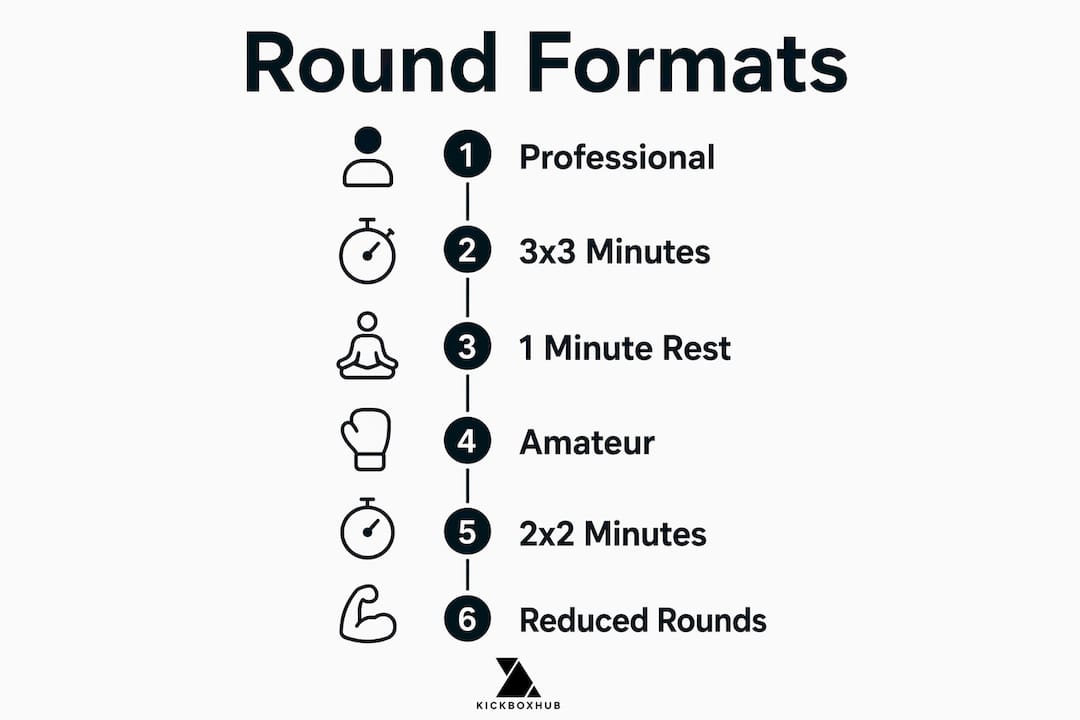
The kickboxing competition format most fighters encounter at the professional level is 3 rounds of 3 minutes with 1 minute of rest between rounds. That structure is the standard for major organizations including GLORY, K-1, and Enfusion. It sounds simple. It is not. Three minutes of high-output kickboxing at championship level is a physiological stress test, and the 1-minute rest window barely allows lactic acid to clear from the legs before the next round begins.
Amateur bouts run shorter. Most amateur formats use 2-minute rounds, sometimes with reduced round counts, to account for developing fighters' conditioning and technical maturity. The gap between amateur and professional round demands is significant. A fighter moving from a 2x2 amateur format to a 3x3 professional structure faces a 50% increase in total fight time per bout.
The table below shows how round formats differ across major organizations and competition levels.
| Organization / Level | Rounds | Round Length | Rest Period |
|---|---|---|---|
| GLORY (Pro) | 3 | 3 minutes | 1 minute |
| K-1 (Pro) | 3 | 3 minutes | 1 minute |
| Enfusion (Pro) | 3 | 3 minutes | 1 minute |
| WAKO (Amateur) | 3 | 2 minutes | 1 minute |
| WKA (Amateur) | 2–3 | 2 minutes | 1 minute |
Some events add a tie-break round when bouts end level after standard rounds. GLORY's Grand Prix format, for example, has used a single extra round to force a decision when judges cannot separate fighters. That extra round, fought on already-taxed legs, often produces the most decisive moments of the night.
Pro Tip: Train your conditioning specifically to your tournament's round format. If your event runs 3x3, your sparring rounds and pad work should mirror that exact structure, not a generalized 5-minute MMA round.
How to enter kickboxing tournaments: registration and weigh-in rules
Getting into a kickboxing tournament requires more administrative precision than most new competitors expect. WAKO mandates that all athletes hold a valid WAKO Pass and active national federation membership before competing. Since 2026, these credentials are verified through the Sportdata platform, and compliance is checked weeks before the event, not at the door. Missing or expired credentials mean no entry, regardless of how prepared you are physically.
The WKA US Nationals runs a similarly strict process. Here is what the registration and weigh-in sequence looks like for a major national event:
- Submit your registration, medical physical, and competition license through the official portal before the deadline. No documents are accepted at check-in.
- Confirm your weigh-in appointment time. Weigh-ins are appointment-based, and the weight recorded on the scale at that appointment is your official weight. There is no re-weigh.
- Verify your pass type. An athlete pass and an official pass are different credentials. Showing up with the wrong type gets you turned away.
- Understand the weight-cutting window. Some organizations allow limited cutting after the official weigh-in; others prohibit any weight adjustment once the scale is locked. Know your organization's rule before you start cutting.
- Bring printed and digital copies of every document. Systems fail. Having both formats protects you.
Rule compliance is enforced starting weeks before the event. That means the fighter who waits until fight week to sort out their WAKO Pass is already behind.
Pro Tip: Coordinate every registration step with your coach or team manager. One person should own the checklist. Splitting responsibility across multiple people is how documents get missed.
What happens at kickboxing events: brackets and fighter advancement
Kickboxing events use two primary competition formats: single-bout arrangements and bracket progressions. Understanding the difference matters because they demand completely different preparation strategies.
In a single-bout format, fighters are pre-matched against one opponent. Win or lose, the event ends for that fighter. These are common in regional shows and professional superfights. Bracket progressions are the format that defines major tournaments. Here is how a standard bracket tournament unfolds:
- Quarterfinals. Eight fighters enter. Four bouts produce four winners. This is often the most unpredictable stage, where upsets happen and conditioning gaps first become visible.
- Semifinals. The four remaining fighters compete in two bouts. Fatigue from the quarterfinal now factors into every exchange. Calf kick accumulation, shoulder fatigue, and cut management all become tactical variables.
- Finals. Two fighters, both carrying the physical cost of earlier bouts, compete for the tournament crown. GLORY's eight-man heavyweight tournament structure follows exactly this model, with all three stages sometimes occurring on the same night.
Tournaments spanning multiple days divide youth and adult divisions across the schedule, with prelims and finals separated to allow recovery. Same-night finals are the brutal format reserved for elite-level events where the ask is total: win three times in one evening or go home.
Judging follows a consistent structure across most major organizations. Three judges score legal strikes, with tie-break criteria applied when rounds end level. WAKO world championship scoring_2007) uses three judges across three rounds, with final-round performance or extra rounds resolving draws.
Pro Tip: Monitor live match timing through platforms like kihapp.com during tournament day. Stay warmed up two fights out from your scheduled bout. Scheduling shifts happen constantly in multi-bracket events, and a cold fighter called to the ring early is a fighter at a disadvantage.
Equipment rules and safety standards at kickboxing competitions
Equipment compliance is the detail that ends careers before they start. WAKO Europe requires all competition gear to carry official WAKO-approved labels. From 2026, fighters presenting non-labeled equipment at fight entry receive a brief correction window. If the issue is not resolved, disqualification follows.
The required equipment list differs between amateur and professional bouts, but the compliance standard is equally strict at both levels:
- Amateur fighters typically require WAKO-labeled gloves, shin guards, headgear, mouthguard, and groin protection. All items must be verified before the fighter enters the competition area.
- Professional fighters generally compete without headgear but must still present approved gloves and any other organization-mandated protective gear.
- Non-compliant gear triggers a warning first. A second failure results in disqualification. There is no third chance.
Understanding equipment labeling regulations eliminates one of the most preventable sources of tournament stress. Fighters who pack and verify gear at home, days before the event, never face this problem at check-in.
Safety standards also govern what happens inside the ring. Referees hold full authority to stop bouts, issue warnings for illegal techniques, and deduct points for fouls. Prohibited techniques vary by organization and discipline, so checking the specific ruleset for your event is not optional. It is preparation.
Pro Tip: Pack your gear bag three days before the event. Check every label. If anything is missing or non-compliant, you have time to replace it. Waiting until the morning of the tournament is a gamble you will eventually lose.
Key takeaways
Kickboxing tournaments require fighters to master the administrative process, equipment compliance, and physical conditioning specific to their organization's format before the first punch is thrown.
| Point | Details |
|---|---|
| Standard pro round format | Most major organizations use 3 rounds of 3 minutes with 1 minute rest. |
| Registration starts early | WAKO and WKA require valid passes and submitted documents weeks before the event. |
| Bracket progression demands stamina | Same-night tournaments require winning multiple bouts; conditioning must reflect that load. |
| Equipment must be labeled | WAKO-approved labels on all gear are mandatory from 2026; non-compliance leads to disqualification. |
| Monitor live scheduling | Use platforms like kihapp.com to track fight order and stay warmed up two bouts out. |
The part nobody tells you before your first tournament
Most fighters spend months preparing their striking and almost no time preparing their paperwork. That imbalance costs more people their tournament entry than any opponent ever has. I have seen technically gifted fighters turned away at weigh-in because their WAKO Pass was expired, or because they brought the wrong document format to a WKA check-in that explicitly stated what was required. The rulebook was public. They just did not read it.
The other thing worth saying plainly: same-night bracket tournaments are a different sport from a single superfight. Winning a quarterfinal and then fighting again two hours later, with bruised shins and a taxed gas tank, tests something that no amount of pad work fully replicates. The fighters who consistently win GLORY-style Grand Prix events are not always the hardest hitters in the bracket. They are the ones who manage output across all three bouts, protect their legs from cumulative calf kick damage, and stay mentally composed when the body is screaming.
If you are attending as a spectator, understanding the bracket structure transforms what you watch. Tracking a fighter like Michael Boapeah fighter profile through a multi-bout tournament, or studying Bahram Rajabzadeh fight history across Grand Prix events, reveals patterns in how elite fighters pace themselves and adapt between bouts. That context is what separates a casual viewer from someone who actually understands what they are seeing.
Go in with your documents sorted, your gear verified, and your conditioning built around your specific round format. The sport rewards preparation at every level.
— Lukas
Track every tournament with KickboxHub
Knowing the structure of a kickboxing event is one thing. Having the data to back it up is another.
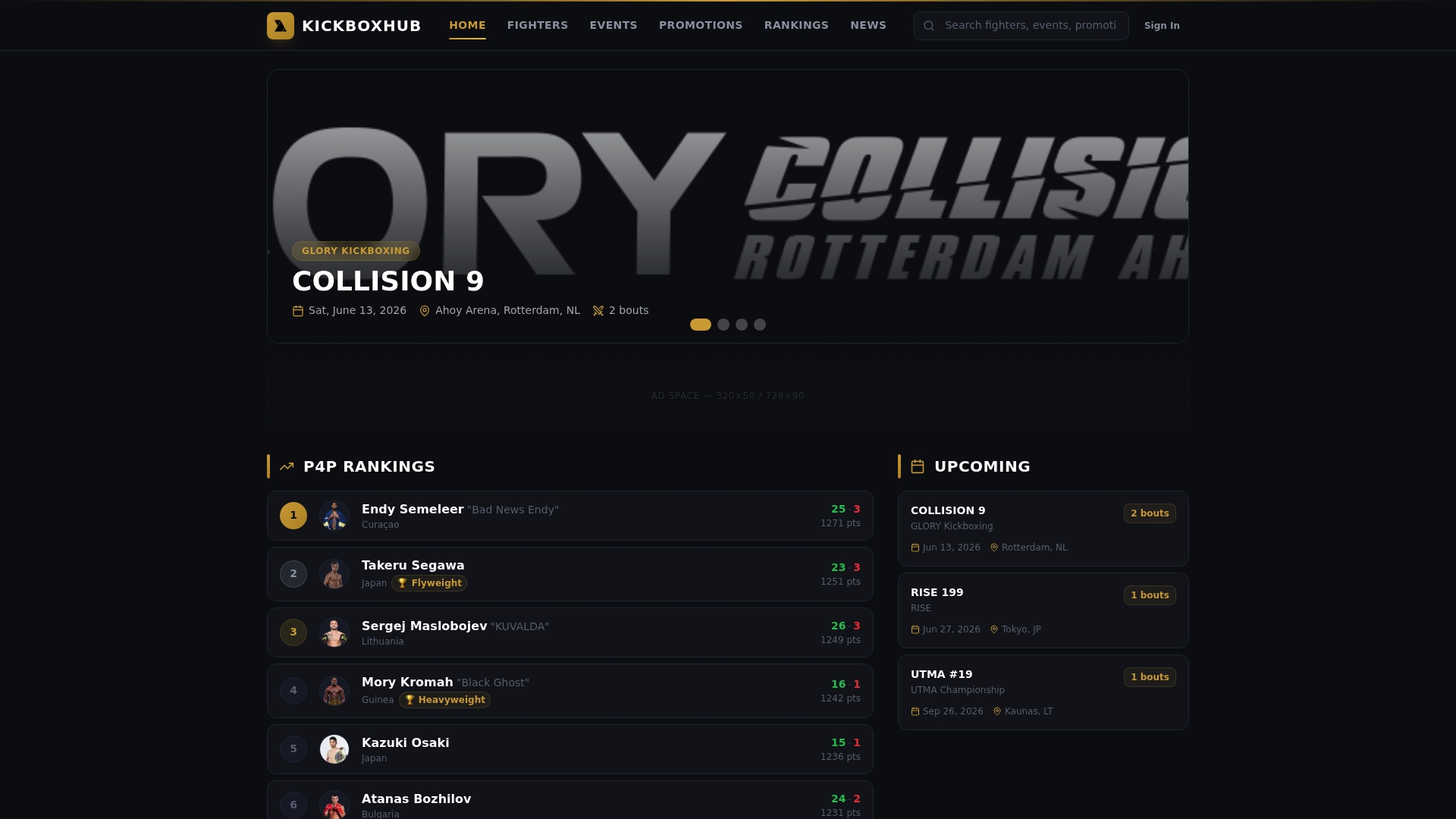
KickboxHub is the most complete kickboxing database available, covering fighters, events, results, and rankings in one place. Whether you are researching an upcoming event through the kickboxing promotions directory or building your pre-tournament preparation by studying opponent records in the fighter database, KickboxHub gives you the information layer that most fighters and fans never access. The gyms and teams directory connects you with training resources and team affiliations that matter when tournament season arrives. Stop guessing. Start knowing.
FAQ
What is the standard round format for professional kickboxing?
Professional kickboxing tournaments typically use 3 rounds of 3 minutes with 1 minute of rest between rounds. Major organizations including GLORY, K-1, and Enfusion follow this structure.
How do you enter a kickboxing tournament?
Fighters must register through the organization's official platform, such as Sportdata for WAKO events, and submit all required documents including a valid competition pass and medical clearance before the deadline. No documents are accepted at the weigh-in itself.
How are winners decided in kickboxing tournaments?
Three judges score each bout based on legal strikes landed. If rounds end level, tie-break criteria or an extra round determine the winner, depending on the organization's ruleset.
What equipment is required to compete?
Required gear varies by organization and competition level, but WAKO mandates that all equipment carry official approved labels from 2026 onward. Amateur fighters typically need gloves, shin guards, headgear, mouthguard, and groin protection.
How do fighters advance in a tournament bracket?
In a standard bracket format, fighters progress through quarterfinals, semifinals, and finals by winning each bout. Some tournaments complete all stages in a single night, requiring fighters to compete multiple times with minimal recovery time between bouts.
Recommended

Comments (0)
Sign in to leave a comment.
No comments yet. Be the first!