
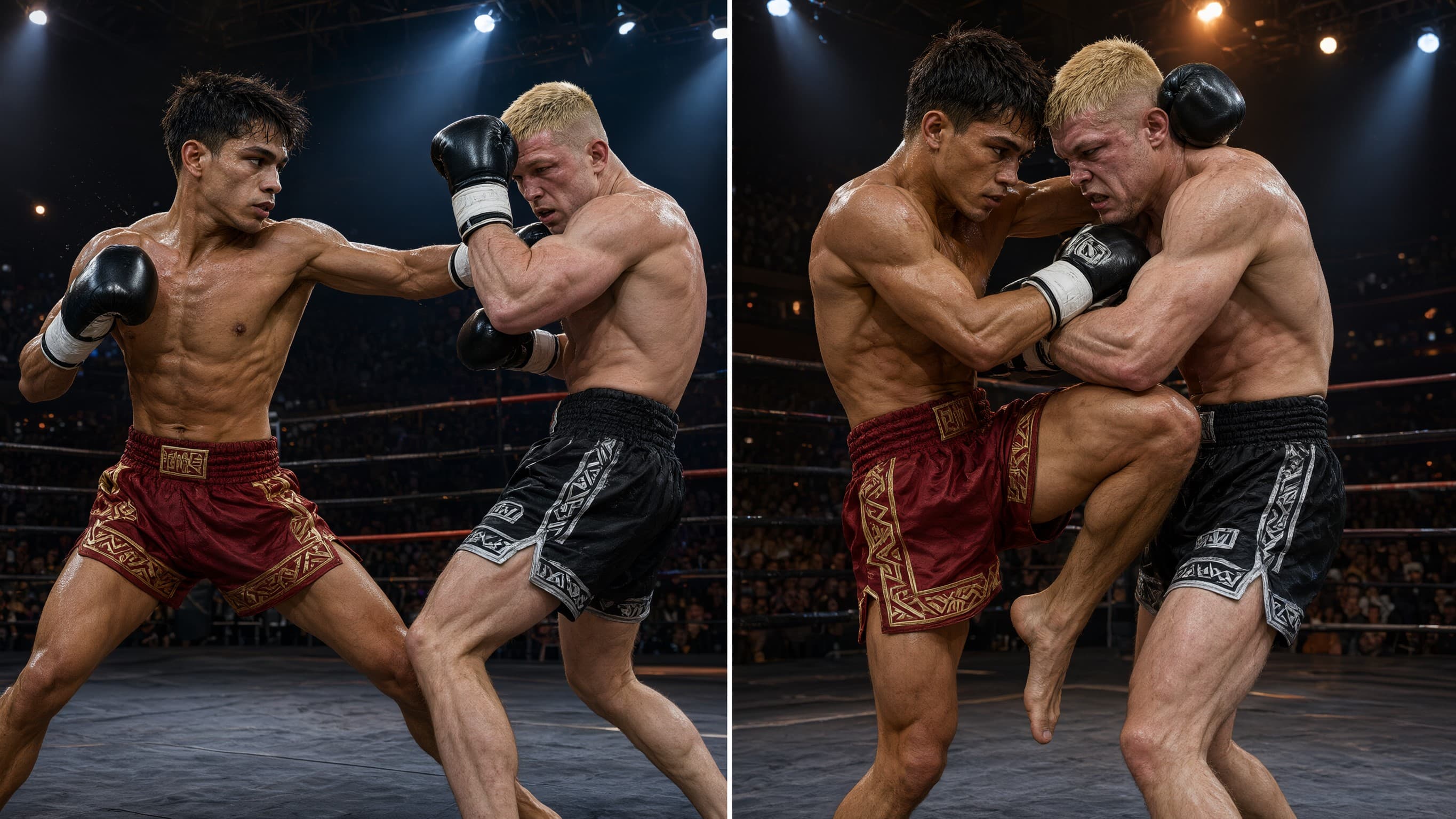
Kickboxing vs Muay Thai: Rules, Scoring and Key Differences
 Lukas
LukasKickboxing and Muay Thai are related stand-up combat sports, but they are not the same competitive ruleset. Muay Thai permits punches, kicks, knees, elbows, sustained clinch fighting, and certain legal off-balancing techniques. Modern K-1-style kickboxing normally permits punches, kicks, and knees, while banning elbows, restricting the clinch, and prohibiting throws.
Those rule differences change more than the list of legal strikes. They affect stance, distance, defensive habits, combinations, judging, and even how a fighter's professional record should be classified.
There is no single rulebook for every event called “kickboxing” or “Muay Thai.” The promotion, sanctioning body, and bout agreement always control. The comparison below describes the formats most fans encounter in major professional competition.
Kickboxing vs Muay Thai at a glance
| Feature | Modern K-1-style kickboxing | Muay Thai |
|---|---|---|
| Core weapons | Punches, kicks, and usually knees | Punches, kicks, knees, and elbows |
| Elbows | Normally prohibited | Legal |
| Clinching | Prohibited or limited to immediate action | A major part of the sport; allowed until the referee breaks inactive action |
| Throws and off-balancing | Generally prohibited | Certain dumps, sweeps, and off-balancing techniques are legal; judo-style throws remain restricted |
| Low kicks | Commonly legal | Legal |
| Catching kicks | Usually tightly restricted | Permitted within the applicable rules, with limits on holding and movement |
| Typical professional rounds | Often 3 × 3 minutes; title fights commonly 5 × 3 | Often 3 × 3 or 5 × 3 minutes, depending on the promotion |
| Scoring | Commonly 10-point must, with organization-specific priorities | Can use 10-point must, but Muay Thai judging evaluates effectiveness within its own technical context |
| Common glove format | Boxing gloves; exact weight varies | Boxing gloves traditionally; some promotions use 4-ounce gloves |
| Professional record | Should be recorded as kickboxing | Should be recorded as Muay Thai |
The simplest practical distinction is this: Muay Thai uses the full striking range of punches, kicks, knees, and elbows together with a developed clinch game. Kickboxing removes elbows and compresses or removes that clinch game to keep the fight at striking range.
Is Muay Thai a type of kickboxing?
In casual language, people sometimes use kickboxing as a broad label for any combat sport that combines punches and kicks. Under that umbrella definition, Muay Thai can be described as a form of kickboxing.
In regulated competition, however, Muay Thai and kickboxing are separate disciplines. They have different legal techniques, judging contexts, bout classifications, and title histories. Major organizations that offer both sports identify each bout by its own ruleset rather than merging them.
ONE Championship provides a clear example. Its official martial arts rules list separate Global Kickboxing and Global Muay Thai rule sets. The kickboxing rules recognize punches, kicks, and knees as legal knockout weapons. The Muay Thai rules also include elbows and legal throws.
For fans, the broad family resemblance is useful. For a fighter database, “close enough” is not precise enough: a Muay Thai result should not silently be counted as a kickboxing result.
Are elbows allowed in kickboxing?
Elbows are one of the clearest differences between the sports.
Elbow strikes are legal and strategically important in Muay Thai. They can be delivered at close range, from the clinch, while an opponent enters, or as part of a combination. Because elbows can cause cuts and sudden knockouts, Muay Thai fighters must manage a close distance that does not exist in the same form under kickboxing rules.
Modern professional kickboxing organizations such as GLORY and ONE prohibit elbow strikes. A fighter who has extensive Muay Thai experience must remove them from the available arsenal when competing in kickboxing, even if the opening would normally invite an elbow.
The absence of elbows also changes defense. Shelling up at short range, entering behind the gloves, and exiting a clinch all carry different risks when elbows are legal.
How are knees and clinching different?
Both sports can permit knee strikes, but the conditions around them differ substantially.
Muay Thai allows fighters to work from an established clinch. They can fight for head and arm position, control posture, land repeated knees, turn an opponent, and use legal off-balancing techniques. The referee separates the fighters when the position becomes inactive or illegal—not simply because a clinch exists.
K-1-style kickboxing generally allows knees while preventing extended clinch fighting. The exact restriction varies. Under GLORY's current rules and clarifications, clinching must lead to immediate legal action; the contest cannot become prolonged grappling. Other organizations may prohibit holding entirely or allow a narrowly defined single attack.
This produces a visible tactical difference:
- A Muay Thai fighter can build offense after securing clinch control.
- A kickboxer normally has to land the knee immediately and resume open-range striking.
- Referees may interpret holding differently across promotions, so the event rulebook matters.
“Knees are legal” therefore does not mean that the two sports have the same knee game.
Can fighters catch kicks or throw an opponent?
Muay Thai permits certain catches, sweeps, dumps, and off-balancing actions, provided they remain within its technical rules. It does not simply allow every wrestling or judo throw. Illegal trips, joint manipulation, lifting, and prohibited throwing mechanics can still draw a warning or foul.
Kickboxing is generally more restrictive. Catching a kick may be prohibited or allowed only for an immediate counter, and sweeping or throwing the opponent is usually illegal. A fighter cannot turn a kickboxing bout into a takedown contest.
This changes the risk of kicking. In Muay Thai, a poorly placed kick may be caught and followed by an attack or legal dump. In kickboxing, the threat is more likely to be an immediate punch, kick, or knee counter under the applicable rules.
How do stance, movement, and combinations differ?
No stance belongs exclusively to one sport, and elite fighters regularly adapt. Still, the rules reward different default habits.
Muay Thai fighters often use a more upright posture that helps them check kicks, lift the lead leg, knee, elbow, and work in the clinch. The rhythm can appear measured because balance and visible effectiveness matter, and because every entry may meet kicks, knees, elbows, or clinch control.
Kickboxers often use more boxing combinations, lateral entries, exits, and punch-to-kick sequences. K-1-style competition rewards fast combinations and continued action at open range. A deeper boxing stance may improve punching and movement, but it must still account for low kicks and knees.
These are tendencies, not definitions. Dutch-style kickboxers, karate-based fighters, pressure fighters, counterfighters, and Muay Thai specialists can all look different while competing under the same rules.
Pro Tip: Identify the rules before judging a fighter's stance. A technical choice that looks passive in one format may be a deliberate answer to the weapons allowed in another.
Is Muay Thai scoring different from kickboxing scoring?
Yes, even when both contests use a 10-point-must framework.
In kickboxing, the judges apply the promotion's ordered criteria. GLORY currently prioritizes knockdowns, high-impact damage, other damage, clean strikes, and then effective aggression or ring domination. ONE's kickboxing criteria include knockdowns, damage, clean strikes, and aggression or ring generalship.
Muay Thai judges evaluate legal, effective Muay Thai technique. Kicks, knees, elbows, punches, clinch control, balance, defensive responses, and the visible effect of attacks are considered within the ruleset. A raw strike counter cannot explain every round because a clean, destabilizing kick or effective clinch sequence may matter more than several low-impact punches.
The International Federation of Muaythai Associations publishes its current rules and regulations for governed competition. Individual professional promotions and commissions may use their own wording, round structure, and judging priorities.
Three principles apply to both sports:
- A legal knockdown can change a round dramatically.
- Effective, clean offense matters more than strikes that miss or are neutralized.
- The actual event rules outrank a generic internet explanation.
For a detailed breakdown of kickboxing scorecards, read How Kickboxing Scoring Works: 10-Point Must, Knockdowns and Decisions.
How many rounds are kickboxing and Muay Thai fights?
Three three-minute rounds are common in modern professional kickboxing, with many championship contests scheduled for five. Professional Muay Thai is often fought over three or five three-minute rounds, depending on the promotion and jurisdiction.
Traditional five-round Muay Thai and a three-round entertainment format can produce different pacing even though both are Muay Thai. Tournament fights can also use special provisions because athletes may compete more than once in a night.
Round count alone cannot identify the discipline. Check the event listing, rules announcement, and official result.
Do kickboxing and Muay Thai use different gloves?
They can, but glove size is promotion-specific rather than a universal dividing line.
Professional kickboxing normally uses boxing gloves. Traditional professional Muay Thai also uses boxing gloves, so photographs of the gloves alone may not distinguish the sports.
Some promotions deliberately use different equipment. ONE's current rules specify 4-ounce mixed martial arts gloves for its Muay Thai contests, while its kickboxing contests use 8-ounce or 10-ounce boxing gloves depending on the weight class. That is a ONE Championship format, not a rule that applies to every Muay Thai event worldwide.
Amateur governing bodies can additionally require headgear, shin guards, body protection, or other equipment based on age and discipline.
Which is harder: kickboxing or Muay Thai?
There is no objective answer. Both are full-contact combat sports, and difficulty depends on the athlete, opponent, level, and rules.
Muay Thai presents more categories of legal attack and a deeper clinch phase. Fighters must defend elbows, prolonged knee exchanges, and legal off-balancing actions. Kickboxing removes some of those weapons but often creates a faster combination pace and more frequent resets at open range.
A world-class contest in either sport demands elite timing, conditioning, defense, tactical judgment, and composure. More legal techniques do not automatically make every individual Muay Thai bout harder than every kickboxing bout.
Can a Muay Thai fighter compete in kickboxing?
Yes. Many athletes cross over successfully, but they must adapt to the new rules.
A Muay Thai fighter entering kickboxing may need to:
- remove elbows from automatic combinations;
- release the clinch after the permitted immediate action;
- avoid legal Muay Thai dumps that become kickboxing fouls;
- adjust to a faster three-round pace;
- increase boxing volume and combination exits;
- understand the promotion's judging priorities.
A kickboxer entering Muay Thai faces the reverse problem: elbows, prolonged clinch work, catches, off-balancing, and the sport's scoring context must all be addressed.
Crossing over does not rewrite the original results. The kickboxing bouts remain in the kickboxing record, while the Muay Thai bouts remain in the Muay Thai record.
Why should kickboxing and Muay Thai records remain separate?
A record is meaningful only when its scope is clear.
If one website combines a fighter's professional kickboxing, Muay Thai, amateur, boxing, and exhibition results into one headline total while another counts only documented professional kickboxing bouts, the two numbers will disagree even if both contain real events.
KickboxHub calculates a fighter's kickboxing W-L total from the documented professional kickboxing bouts currently stored for that athlete. It does not manually change the total to match an unsupported biography, social post, or promotional graphic. Missing historical evidence can make the database incomplete, but an unknown result should not be invented.
Each documented bout should connect the athlete to an opponent, event, date, discipline, and official result. Read Why Kickboxing Records Disagree: Pro vs Amateur Fights for the complete methodology.
How can you tell which rules a fight uses?
Before the opening bell, check:
- The discipline label. Does the event call the bout kickboxing, K-1 rules, Muay Thai, or something else?
- The legal-strike announcement. Elbows and clinch rules provide the fastest distinction.
- The promotion's official rulebook. Do not transfer one organization's rules to another.
- The bout equipment. It can be a clue, but it is not conclusive by itself.
- The official result. Reliable records should preserve the discipline under which the result occurred.
If a card contains both kickboxing and Muay Thai, never assume every bout follows the main event's rules.
Common misconceptions
“Muay Thai is just kickboxing with elbows”
Elbows are an obvious difference, but not the only one. Clinch duration, off-balancing, kick catches, scoring context, stance, and tactical rhythm also change.
“Kickboxing does not allow knees”
Many major professional and K-1-style rulesets allow knees. What they restrict is prolonged holding and clinch fighting. Some other kickboxing disciplines use different rules.
“Muay Thai always uses small gloves”
No. Traditional and many professional Muay Thai contests use boxing gloves. Four-ounce Muay Thai is a promotion-specific format used by organizations such as ONE.
“Whichever fighter lands more strikes wins”
Judging is not a simple click counter. Knockdowns, damage, clean legal technique, effectiveness, balance, and organization-specific priorities determine the score.
“A fighter has one universal combat-sports record”
Kickboxing, Muay Thai, boxing, MMA, amateur, and exhibition results should be classified rather than silently merged.
Key takeaways
| Question | Short answer |
|---|---|
| Are kickboxing and Muay Thai the same? | No; they are related but distinct competitive disciplines |
| Are elbows legal? | Muay Thai: yes. Modern kickboxing: normally no |
| Are knees legal? | Yes in Muay Thai and in many major kickboxing rulesets |
| Is clinching legal? | Central to Muay Thai; prohibited or tightly limited in kickboxing |
| Are throws legal? | Certain Muay Thai off-balancing techniques are legal; kickboxing generally prohibits them |
| Do both use 10-point must? | Often, but the judging criteria and technical context differ |
| Are the records combined? | They should remain discipline-specific |
| Which is better? | Neither universally; the answer depends on the athlete's goal and preferred rules |
Kickboxing emphasizes stand-up striking under a compressed ruleset built for punches, kicks, knees, and open-range action. Muay Thai adds elbows, sustained clinch offense, and legal off-balancing to create a different technical problem. Understanding that difference makes fights easier to follow and records easier to trust.
— Lukas
Explore fighters, events, and verified results
Browse the KickboxHub fighter database for documented professional kickboxing records, check upcoming events, or explore results by promotion.
If you are new to the sport, continue with What Is Kickboxing? Rules, Styles and How Fights Work. For deeper context, read the guides to kickboxing scoring and weight divisions.
FAQ
What is the main difference between kickboxing and Muay Thai?
Muay Thai permits punches, kicks, knees, elbows, sustained clinching, and certain legal off-balancing techniques. Modern K-1-style kickboxing normally permits punches, kicks, and knees but bans elbows, restricts the clinch, and prohibits throws.
Is Muay Thai considered kickboxing?
It can be placed within the broad family of sports that combine punches and kicks, but regulated Muay Thai and kickboxing are separate disciplines with distinct rules and records.
Are elbows allowed in kickboxing?
Elbows are normally prohibited in major professional kickboxing rulesets. They are legal and fundamental in Muay Thai.
Can you knee in kickboxing?
Yes, knees are legal in many K-1-style and professional kickboxing rulesets. The clinch used to deliver them is normally much more restricted than in Muay Thai.
Does kickboxing have clinching?
Some rulesets allow a brief clinch followed by an immediate strike, while others prohibit holding. They do not normally allow the extended clinch exchanges found in Muay Thai.
Which has more weapons, kickboxing or Muay Thai?
Muay Thai has more categories of legal attack because it includes elbows and a broader clinch and off-balancing game in addition to punches, kicks, and knees.
Do Muay Thai fights count on a kickboxing record?
They should not be silently combined. A transparent database should classify Muay Thai and kickboxing bouts separately, even when the same athlete competes in both sports.
Recommended

Comments (0)
Sign in to leave a comment.
No comments yet. Be the first!