

Why Kickboxing Fighter Records Matter for Your Career
 Lukas
LukasA kickboxing fighter record is the primary quantitative measure of a competitor's professional activity, fight outcomes, and finishing ability. Every coach, matchmaker, analyst, and serious fan starts their evaluation there. But understanding why kickboxing fighter records matter requires pushing past the headline numbers into the layered context that separates a meaningful record from a misleading one. Win-loss tallies are the opening sentence of a fighter's story, not the full chapter. The importance of fight records lies in what they reveal when read correctly: competitive exposure, performance trends, and the quality of opposition faced across a career.
Why kickboxing fighter records matter beyond the win-loss column
Fighter records signal two things immediately: activity level and fight outcomes. A fighter with 40 bouts has absorbed pressure, managed weight cuts, and navigated fight-week chaos in ways a 10-fight prospect simply has not. That experience compounds. It shows up in poise under fire, in the ability to adjust mid-round, and in the physical conditioning that only repetition builds.
The problem is that raw win-loss records can mislead as easily as they inform. An undefeated record might mask a career built entirely against weak opposition. A fighter with five losses might have compiled them against world-ranked opponents, which tells a completely different story about competitive quality. The record itself is a filter, not a conclusion.
Modern data frameworks resolve this by treating records as a dynamic calculation rather than a static archive. On advanced tracking platforms, every fighter begins at a baseline of 1000 points. From there, your career value updates using algorithmically weighted parameters: expected match outcomes, opponent strength, victory methods, and championship stakes. When you read a fight record through this lens, a simple win over an elite fighter scales your status far higher than stacking ten consecutive victories over unranked opponents.
"Win/loss numbers are filters, not conclusions — undefeated streaks can mask weak opposition; layered analysis that includes fight context improves matchup understanding." — What Fighter Records Actually Tell Us Before a Fight
What makes kickboxing record analysis genuinely useful is the method of victory data embedded within it. A fighter who wins 80% of bouts by knockout tells you something about their striking power and finishing instinct. A fighter who wins 80% by decision tells you something about their technical control and cardio.
Key dimensions that give a record real meaning:
- Fight frequency: How often does the fighter compete? High activity suggests peak conditioning and matchmaker confidence.
- Method of victory: KO, TKO, split, or unanimous decision wins each carry completely different tactical implications.
- Method of defeat: A loss by KO signals a structural defensive vulnerability, whereas a split decision loss signals elite structural resistance.
- Recency: A fighter's last three to five bouts carry more predictive weight than their career totals.
- Opponent ranking: Wins against highly rated opponents yield significantly higher career equity than wins against unranked fill-ins.
How opposition quality and career phases change everything
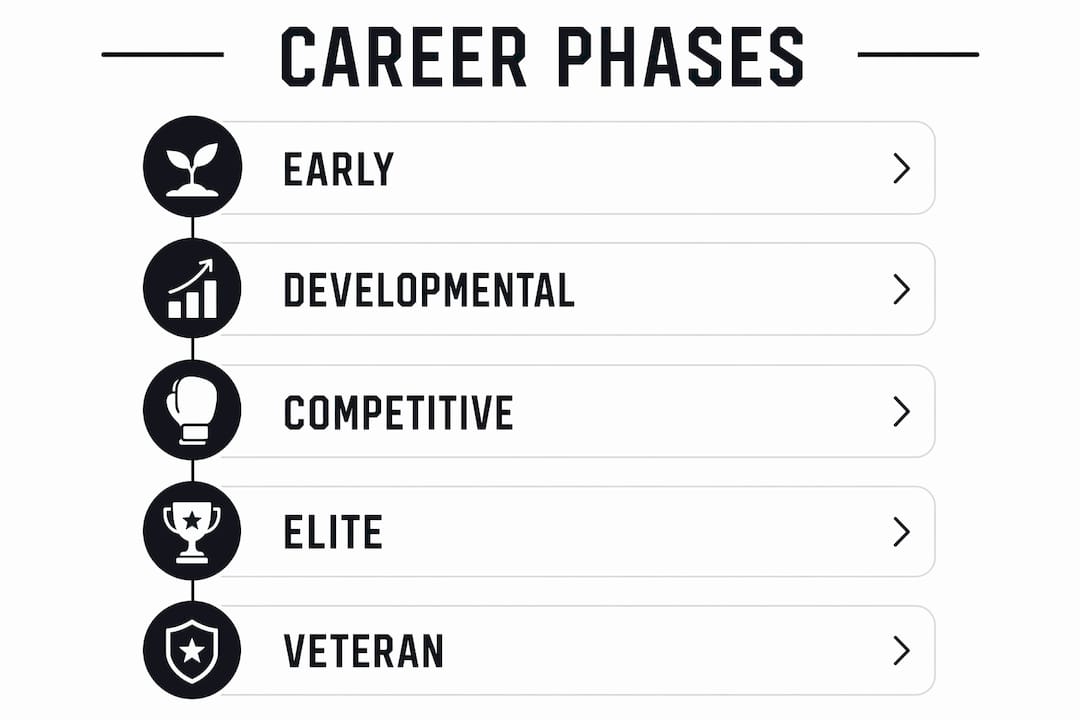
The most sophisticated piece of kickboxing records significance is opposition quality. Two fighters can share an identical 20-5 record and represent entirely different competitive tiers. The framework that resolves this is career phase analysis, a method that segments a fighter's career into early, intermediate, and competitive phases, each evaluated against the quality of opposition faced at that stage.
To calculate this accurately, data systems apply a floating volatility matrix (known as the K-factor) to evaluate how much weight a single bout result should carry based on a fighter's career development tier.

| Career phase | Opposition profile | Volatility Matrix (K-Factor) | What the record reveals |
|---|---|---|---|
| Early (bouts 1-8) | Developmental, unranked opponents | High Volatility (K=60) | Basic durability, foundational activity, and raw finishing instinct. |
| Intermediate (bouts 9-20) | Regional-level, some ranked fighters | Standard Volatility (K=32) | Technical growth, pressure response under adversity, and style adaptability. |
| Competitive (bouts 21+) | Ranked, elite, or world-level opponents | Stabilized Elite (K=20) | True world-class ceiling, championship temperament, and elite tier durability. |
Promoters play a direct role in shaping early-phase records. Matchmakers often select manageable opposition during a prospect's first eight to twelve fights, building confidence and a winning record while the fighter develops. This is standard practice, not manipulation. But it means that a 10-0 record with no ranked opponents is a developmental marker, not a competitive credential.
Matchmakers and coaches informally perform this phase-and-tier analysis constantly. They focus on performance at higher opposition tiers rather than career totals, because that is where the real signal lives. A fighter who goes 3-2 against top-ten opponents in their weight class has proven far more than a fighter who goes 15-0 against regional fill-ins.
💡 Pro Tip: When evaluating any fighter's record, isolate their results from the competitive phase only. Strip out the early developmental wins and assess the record that remains. That number is the one that actually predicts elite performance.
How methods of victory shape reputation and fight narratives
Stoppage records carry weight that extends well beyond the scorecards. KO and stoppage histories heavily influence fan perception and betting behavior, with fighters known for knockouts generating disproportionate pre-fight attention and wagering interest before major bouts. That reputation is a competitive asset. It forces opponents to fight defensively, which opens angles and creates hesitation at the worst moments.
This human perception aligns directly with backend sports science metrics. In modern ranking formulas, not all victories move a fighter's career score equally. For instance, securing a victory via a clean KO or TKO applies a 1.2x boost multiplier to a fighter’s rating advancement. Conversely, squeaking out a split or majority decision applies a 0.8x reducer penalty to that rating movement.
Furthermore, when an athlete steps up to a championship bout, a 1.15x title-stakes multiplier is stacked on top of the equation. If an elite athlete manages a knockout performance in a world-championship main event, these compounding multipliers accelerate their career score dramatically, reflecting the true magnitude of the feat on the global leaderboards.
The mechanics of how records affect reputation:
- High KO percentage builds psychological leverage. Opponents who know they are facing a proven finisher carry that knowledge into camp and into the ring. The mental weight of facing a knockout artist changes game plans before the first bell.
- Stoppage wins in competitive phases carry maximum credibility. A KO over a ranked opponent in the intermediate or competitive phase signals genuine finishing power, not just matchmaking advantage.
- Decision wins against elite opponents signal technical mastery. Outpointing a world-class fighter over three rounds requires superior technique, conditioning, and tactical discipline.
- Losses by KO flag specific vulnerabilities. Repeated stoppages in the same manner, whether by body shot, head kick, or overhand right, point to a structural defensive problem that opponents will target.
Research into elite K-1 kickboxing confirms that specific technical actions link directly to win probability. A rear-hand uppercut to the head increased win odds by 23.0%, while a lead-hand hook increased them by 17.3%. This means that fighters who accumulate KO wins through these specific techniques are not just lucky finishers. They are executing technically superior patterns that the record reflects as outcomes.
How to use fight records for training focus and career planning
Converting a raw record into rates is the first practical step for any aspiring fighter or serious analyst. Derived metrics from raw records including win percentage, KO percentage, and finish rate provide far more context than the headline numbers alone.
However, evaluating real ring status requires understanding the critical difference between Stored vs. Displayed scores. While your baseline historical points remain permanently stored in the database architecture, your displayed public score is heavily dependent on an activity-aware tracking system.
If a fighter suffers from ring rust and remains out of action for 12 to 24 months, their ranking drops by an automatic -20% display deduction. If inactivity stretches past 24 months, that display penalty scales up to -50%, eventually wiping out their active ranking footprint entirely if they cross a 36-month shelf life.
Translating data into career choices:
- Analyze your frequency decay parameters: Fighting fewer than 3 times over a rolling 2-year window applies frequency-based inactivity deductions (ranging from -10% down to -40%). If your record is declining despite technical wins, it means your career planning is lacking the necessary activity volume.
- KO percentage above 50% indicates finishing ability. Fighters with this profile should prioritize combination work and setup techniques, specifically the rear-hand uppercut and lead hook sequences that research links to winning.
- High decision win rate with low finish rate points to technical control but possible power deficiency. Strength and conditioning work, combined with power-generation mechanics, can shift this ratio.
- Losses by KO in the head signal a defensive posture problem. Excessive blocking, which research shows decreases win odds, is often the culprit. Footwork and head movement training directly addresses this.
Record analysis works best when combined with technical video review. The numbers tell you what happened; the footage tells you why. Up-and-coming athletes like Achilleas Karapiperis, whose fight history reflects early competitive exposure, illustrate how a small sample of bouts against real opposition reveals more than a padded win streak. Demographic factors like birth quarter have no significant impact on elite kickboxing success, which means the record differences you see between fighters come down to training process and fight selection, not birth lottery.
Key takeaways
Fighter records in kickboxing are meaningful only when read through the lens of opposition quality, career phase, and method of victory — not as standalone win-loss tallies.
| Point | Details |
|---|---|
| Records are filters, not verdicts | Raw win-loss numbers require opposition quality and fight context to carry predictive value. |
| Career phase analysis is non-negotiable | Early-phase wins against weak opponents do not translate to competitive-phase credentials. |
| Method of victory shapes reputation | KO records influence opponent psychology, betting markets, and fight narratives beyond the scoreboard. |
| Convert records into rates | Win %, KO %, and finish rate reveal style and training priorities that raw numbers obscure. |
| Activity dictates public ranking status | Inactivity penalties surgically deduct your displayed score while keeping your underlying stored data intact. |
Records reveal character, but only if you know how to read them
I have spent years watching analysts and fans treat fight records like batting averages, as if a higher number automatically means a better fighter. It does not. The most dangerous fighter I ever saw walk into a gym had a 6-4 record. Every one of those losses came against ranked opponents in the competitive phase. Every one of those wins came by stoppage. That record screamed elite potential to anyone who knew how to read it.
What I have found is that the fighters who understand their own records analytically develop faster. They know which losses exposed structural problems and which wins confirmed technical strengths. They use that data to prioritize training blocks rather than guessing. A fighter who lost three decisions in a row by close margins against top-ten opponents is not in crisis. They are one technical adjustment away from a winning streak.
The uncomfortable truth is that most fighters and fans stop at the headline number. They see 20-0 and assume dominance. They see 10-5 and assume mediocrity. Neither assumption survives contact with phase analysis and opposition quality data. The record is the starting point of the conversation, not the end of it. Read it with that mindset and you will see fighters, matchups, and career trajectories with a clarity that the headline-readers simply cannot access.
— Lukas
Track every record, result, and ranking on Kickboxhub

Kickboxhub is the most comprehensive kickboxing database available, built specifically for fans and fighters who want more than surface-level stats. The specialized Kickboxhub fighter database covers verified records, career results, and opponent histories across every major promotion, giving you the opposition quality context that raw records cannot provide alone.
To see exactly how these data vectors convert dynamically into live leaderboards, review our official KickboxHub Data & Ranking Methodology statement to explore how K-factors, method multipliers, and activity filters are integrated into our core infrastructure. Explore our extensive Kickboxhub promotions and results directory to see how records are being built right now, across every weight class and organization that matters.
FAQ
What does a kickboxing fighter record include?
A kickboxing fighter record typically includes total wins, losses, and draws, broken down by method of victory such as KO, TKO, and decision. Some databases also track no-contests and disqualifications.
Why do fighter stats matter more than just wins and losses?
Fighter stats like KO percentage, finish rate, and win percentage against ranked opponents reveal style, finishing ability, and competitive quality that a raw win-loss record cannot capture alone.
How does opposition quality affect a fighter's record?
Opposition quality is the single most important modifier of record meaning. A 20-0 record against unranked opponents carries far less weight than a 15-5 record compiled against ranked, world-level competition.
Can losses actually improve a fighter's perceived value?
Yes. Losses against high-level opponents in the competitive phase signal toughness and elite exposure. Records can mislead in both directions, and a loss to a world champion often raises a fighter's stock more than a win against a weak opponent.
How should aspiring fighters use their own record for career planning?
Aspiring fighters should convert their record into rates, isolate results from the competitive phase, and identify whether losses cluster around specific fight phases or techniques. That analysis directly informs training priorities and matchmaking decisions.
Recommended

Comments (0)
Sign in to leave a comment.
No comments yet. Be the first!