
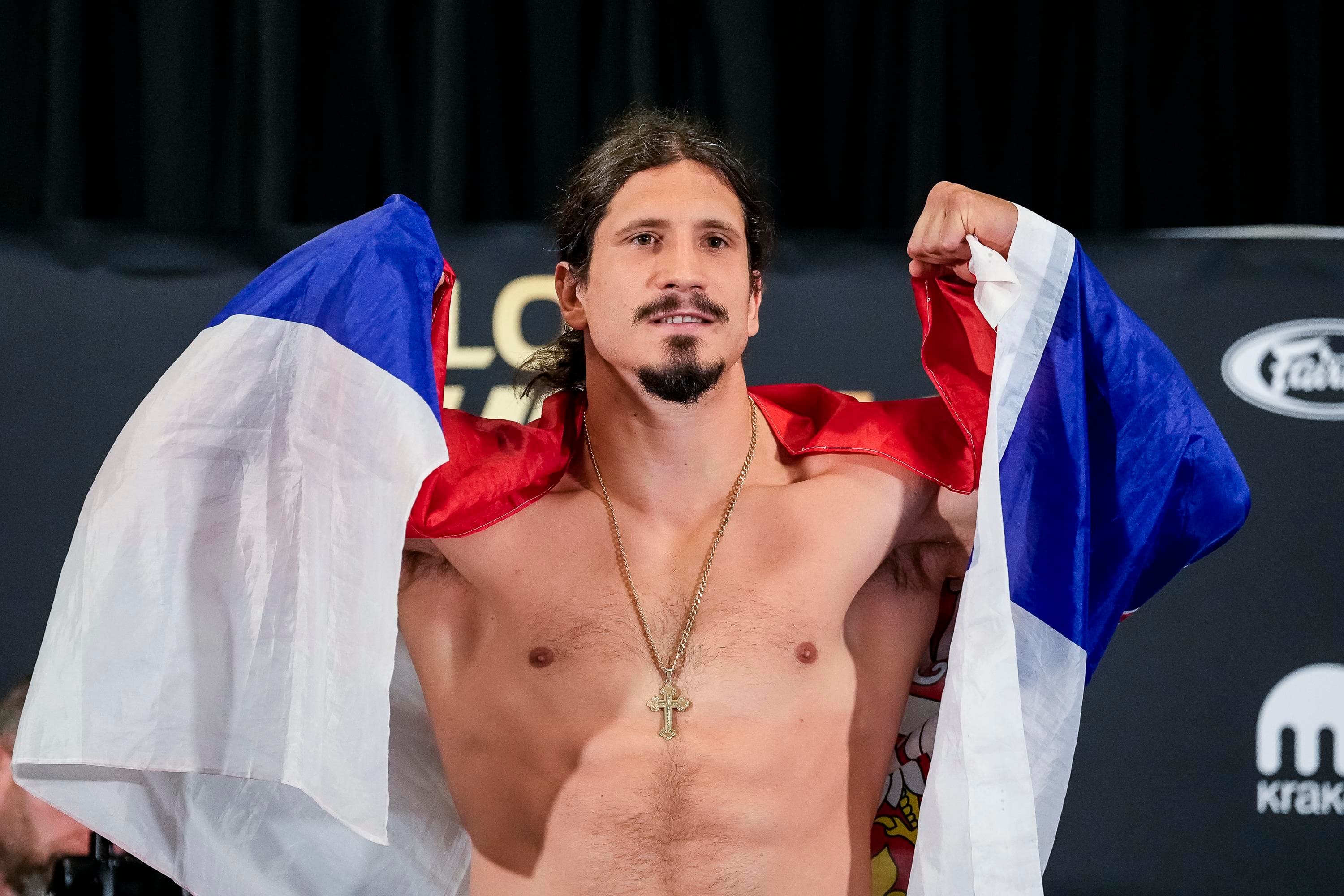
Miloš Cvjetićanin Fighting Style: Hooks and Creative Kicks
 Lukas
LukasMiloš Cvjetićanin is a creative boxer-kicker who combines fast hands, body attacks and counter hooks with a much wider kicking arsenal than opponents can safely ignore. He can pressure behind combinations, intercept an advancing fighter or suddenly change the line of attack with a front kick, high kick, spinning technique or jump.
The spectacular techniques are real, but they are not the foundation of his success. Cvjetićanin first makes opponents deal with his pace, boxing and changes of level. The unusual attack becomes dangerous because it arrives inside a system that already forces several conventional reactions.
That versatility helped the Serbian compete successfully at both light heavyweight and heavyweight, defeat opponents much larger than him, win two fights in one night more than once and earn GLORY's 2025 Fighter of the Year award. It has also met clear limits against disciplined pressure and Mory Kromah's length and knees.
This breakdown explains how Cvjetićanin's style works, where it can be tested and what four revealing case studies show about him.
Who is Miloš Cvjetićanin?
Miloš Cvjetićanin is a Serbian kickboxer from Novi Sad who competes in GLORY's light-heavyweight and heavyweight divisions. He is listed at 189 cm and 95 kg, although his heavyweight tournament weigh-ins have been higher. He joined GLORY in 2024 and became one of the promotion's most active fighters.
At the time of publication, KickboxHub calculates a 15-4 professional record from the completed bouts stored in its database. GLORY's official fighter profile advertises a broader 19-6 career record and a 9-4 GLORY record. The totals have different scopes and should not be merged or manually reconciled.
| Detail | Current information | Scope/source |
|---|---|---|
| Nationality | Serbia | KickboxHub and GLORY |
| Height | 189 cm / 1.89 m | KickboxHub and GLORY |
| Listed weight | 95 kg | Current light-heavyweight listing |
| KickboxHub record | 15-4 | Documented completed professional bouts stored by KickboxHub |
| GLORY career record | 19-6 | Broader record advertised on GLORY's profile |
| GLORY promotional record | 9-4 | Fights counted by GLORY in its own promotion |
| Recognition | GLORY 2025 Fighter of the Year | Eight fights across three tournaments in 2025 |
| Next listed fight | Donovan Wisse, December 12, 2026 | COLLISION 10 at 95 kg |
For the latest bout-by-bout results, physical statistics and schedule, see the Miloš Cvjetićanin fighter profile.
Cvjetićanin also has a substantial amateur background. WAKO's official ranking profile records bronze-medal results at the 2021 Hungarian World Cup in K-1 and the 2022 European Championships in low kick, both at 91 kg. That experience helps explain why his creativity is supported by tournament awareness and sound fundamentals rather than existing only as highlight material.
What is Miloš Cvjetićanin's fighting style?
Cvjetićanin is best described as a creative, combination-based kickboxer. GLORY has called him an artist in the ring; the promotional language fits because he is willing to improvise, but “unpredictable” alone does not explain what makes the style effective.
His system has several connected parts:
- Fast boxing establishes pressure and makes opponents commit to a high guard.
- Hooks and uppercuts punish opponents who enter or remain in the pocket.
- Front kicks attack the body and interrupt forward movement.
- High kicks and spinning attacks make a predictable boxing defense unsafe.
- Changes of level move attention between the head, torso and legs.
- Footwork and speed help him compete with naturally larger heavyweights.
- Tournament experience lets him adjust pace and tactics when another fight may follow.
In a 2026 interview with Sportal, Cvjetićanin explained that an earlier coach emphasized simplicity, while his current coach encourages experimentation. He described adding spinning heel techniques and jumps because he does not want his style to become basic. That is a useful description of the balance in his game: simple attacks create the structure, and invention expands the number of problems an opponent must solve.
1. Fast boxing creates the platform
Cvjetićanin's hands are the most dependable route into his offense. He can step forward behind straight punches, exchange at middle range or wait for an opponent to initiate and answer with a hook. The speed of the first punches matters because it forces a defensive decision before the more unusual techniques appear.
His boxing is not used only to hunt the head. Punches to the body lower the guard and make an opponent more conscious of the centre line. Once the elbows narrow or the hands begin changing position, the next attack can travel upstairs or arrive as a kick.
The two victories over Cem Cáceres illustrate the damage his hands can create. Their first meeting ended by doctor stoppage after Cvjetićanin's offense damaged Cáceres's nose. In the rematch, Cvjetićanin intercepted an attacking Cáceres with a hook and produced a first-round knockout. Different endings came from the same broader strength: he is dangerous both when building combinations and when placing one compact counter into an opponent's entry.
2. He changes levels and lines quickly
Many kickboxers mix punches and kicks. Cvjetićanin's distinction is how suddenly the target and trajectory can change.
A conventional combination can be followed by a front kick through the centre, a high kick around the guard or a spinning attack from a line the opponent was not expecting. He does not need every ambitious technique to land cleanly. Showing them changes the opponent's risk calculation and can make a standard punch or body kick easier to place later.
His front kick against Sofian Laidouni at GLORY 105 is the clearest example of function rather than spectacle. Cvjetićanin took the centre and sent the larger heavyweight down with a front kick to the body in the opening round. The strike attacked Laidouni's balance and torso while preserving distance; it was a practical solution to a bigger opponent, not a decorative technique.
3. The hook counter punishes forward pressure
Cvjetićanin can lead, but some of his sharpest moments occur when an opponent believes it is safe to take the initiative.
As the opponent steps into punching range, Cvjetićanin can hold his position long enough to fire a short hook through or around the entry. This is what makes his pressure-versus-counter balance difficult to read. Giving ground does not necessarily mean he has surrendered the exchange; he may be creating the distance and commitment needed for the counter.
The Cáceres rematch ended through this kind of interception. Against Anis Bouzid at GLORY 105, Cvjetićanin was limited by a dislocated toe and could not move with his usual freedom, yet he still dropped Bouzid with a left hook near the end of the first round as Bouzid attacked. The same weapon worked in two very different physical circumstances.
4. Creativity is controlled by ring awareness
An inventive technique is valuable only if the fighter understands when the risk is justified. Cvjetićanin has learned to operate in one-night tournaments, where energy management and damage avoidance can matter as much as winning the immediate exchange.
At GLORY 104 he first defeated Alin Nechita by unanimous decision, then faced the much taller Rade Opačić in the tournament final. Cvjetićanin had to close distance without walking onto Opačić's long attacks, while still preserving enough activity to win a close decision after already completing one fight.
His own account after the tournament emphasized opponent study, exploiting specific weaknesses and conserving strength in the first bout. That tactical discipline is important. Cvjetićanin's style looks free-form, but his tournament success depends on preparation and selective risk rather than constant improvisation.
5. He can fight above his natural division
Cvjetićanin is currently listed at 95 kg, the light-heavyweight limit, but much of his recent success came against heavyweights. He weighed 101.4 kg for Colin George and 99.5 kg for Sofian Laidouni, still giving away significant mass to several opponents.
The trade-off is clear. Larger heavyweights can carry more clinch weight and one-shot power, but Cvjetićanin can make them solve problems at a faster pace. His speed, combinations and target changes force a big opponent to turn, reset and defend more decisions than a slower heavyweight exchange might normally require.
The split-decision victory over Nabil Khachab, who was approximately 60 kg heavier, is the most extreme example. Size remained a real danger and the scorecards were divided, but Cvjetićanin's agility and activity prevented the fight from becoming a simple contest of mass.
That success should not be interpreted as size never mattering. Moving between divisions asks him to alter distance, physical preparation and acceptable risk. His return to 95 kg against Donovan Wisse therefore presents a different tactical problem from facing a 120- or 160-kg heavyweight.
What the GLORY statistics show—and what they do not
GLORY's fighter profile lists a 7:3 knockdown ratio and an average fight time of 7:16. Those figures fit what his fights show: Cvjetićanin creates damaging moments, but he is not dependent on a first-minute knockout and has repeatedly completed full three-round decisions.
The profile also displays 3.66 strikes landed per minute, 8.63 absorbed per minute and a striking differential of 5.0. Those three displayed values are internally inconsistent if “differential” means landed minus absorbed, so they should not be used to calculate a precise defensive conclusion without clarification from GLORY.
The broader lesson can still be stated carefully. Cvjetićanin participates in active exchanges, has produced more knockdowns than he has absorbed in GLORY's displayed data and is willing to accept some defensive exposure to maintain initiative. Promotional statistics cannot distinguish a blocked strike from a clean power shot in every context, and they do not explain opponent quality, tournament fatigue or weight differences.
Four tests that explain Miloš Cvjetićanin's style
These four case studies show different parts of the system: speed against extreme size, repeatable counter power, tactical resilience in a tournament and the range problem that has so far prevented him from beating Mory Kromah.
1. Nabil Khachab: speed and activity against extreme size
At GLORY 99, Cvjetićanin faced Nabil Khachab in the opening stage of Last Heavyweight Standing. GLORY described the matchup in advance as size versus agility, and the physical contrast was unusually large: Khachab was approximately 60 kg heavier.
Cvjetićanin could not afford to let the contest settle into prolonged static exchanges. His route was to make Khachab move, score before the larger fighter could establish his preferred position and exit before the size difference became decisive.
Cvjetićanin won by split decision. The divided scorecards matter because this was not effortless domination; Khachab's mass and pressure remained meaningful. What the result proved was that Cvjetićanin could impose enough speed, accuracy and activity to make a radically larger opponent compete on technical terms.
The official GLORY 99 results record the split decision and the scale of the weight difference.
2. Cem Cáceres: the same matchup, two damaging answers
Cvjetićanin fought the aggressive, power-punching Cem Cáceres twice in 2025 and stopped him in the first round both times.
The first meeting at GLORY 100 ended by doctor stoppage after Cvjetićanin's offense caused significant damage to Cáceres's nose. The rematch at COLLISION 8 was more conclusive. Cáceres tried to attack, Cvjetićanin found the opening with a short hook, and the fight ended after 70 seconds.
The repeat success is tactically important. Cáceres had already experienced Cvjetićanin's speed and had months to prepare for the rematch, yet the Serbian again found an early answer. Cvjetićanin did not need a spinning technique or a long combination; the threat of his wider arsenal helped create a moment for compact counter boxing.
GLORY's COLLISION 8 results record the first-round knockout, while the promotion's fight analysis describes Cvjetićanin's relentless pace, fearless approach and powerful boxing.
3. Sofian Laidouni and Anis Bouzid: adaptability after injury
The GLORY 105 tournament is the strongest evidence for Cvjetićanin's competitive resilience.
Against Sofian Laidouni, he took the centre, attacked the body and scored two knockdowns on the way to a unanimous decision. One came from a front kick to the torso. During the fight, however, Cvjetićanin dislocated his big toe.
He was medically cleared and returned for the semifinal against Anis Bouzid. The injury reduced his normal movement and made him more static, but he adapted instead of attempting to reproduce the same style with a damaged base. When Bouzid attacked late in the first round, Cvjetićanin countered with a left hook and scored a knockdown. He completed another decision win.
The injury eventually prevented him from contesting the final against Mory Kromah. That withdrawal should not be presented as a competitive loss, nor should the two preceding victories be romanticized as evidence that injuries do not matter. The useful lesson is narrower: Cvjetićanin recognized which weapons remained available and changed the way he fought under severe physical constraint.
GLORY's tournament report confirms that the toe injury accumulated across two wins and ruled him out of the final. The promotion has also published the full Cvjetićanin–Laidouni fight.
4. Mory Kromah: the range and central-lane problem
Kromah has beaten Cvjetićanin twice, first by unanimous decision at COLLISION 7 and then by third-round flying-knee knockout in their 2026 heavyweight title fight.
The matchup exposes the hardest question for Cvjetićanin's style. His creativity works best when he can enter behind combinations, change levels and make the opponent react. Kromah's length and movement make the entry itself dangerous, while the knee threatens the central lane Cvjetićanin must cross to establish his boxing.
In the first meeting, Cvjetićanin competed closely enough that all five judges scored it 29-28, but Kromah still won every card. In the rematch, Cvjetićanin had five scheduled rounds and more heavyweight experience, yet the champion's flying knee ended the fight at 1:55 of round three.
The loss does not erase Cvjetićanin's strengths. It identifies a specific boundary: against a long, mobile opponent with an elite intercepting knee, forward commitment and an upright entry can become liabilities. More pressure is not automatically the answer if that pressure travels through the opponent's strongest weapon.
The official COLLISION 7 results contain the first scorecards, and the COLLISION 9 results record the title-fight knockout.
For the same matchup from the champion's tactical perspective, read the Mory Kromah fighting-style breakdown.
Miloš Cvjetićanin's main strengths
| Strength | Why it matters |
|---|---|
| Creative but functional variety | Opponents must account for conventional combinations, body attacks, high kicks and spinning or jumping techniques. |
| Fast, damaging boxing | His hands establish pace and produced two first-round stoppages over Cem Cáceres. |
| Hook counters | Forward pressure can give him the commitment needed to land a short counter, as shown against Cáceres and Bouzid. |
| Body attacks | Front kicks and punches to the torso change posture, drain energy and open head attacks. |
| Speed across two divisions | He can force larger heavyweights to turn and reset instead of accepting a static strength contest. |
| Tournament adaptability | Multiple two-win tournament nights show preparation, energy management and the ability to change plans. |
| Competitive resilience | He won twice at GLORY 105 despite dislocating his toe in the opening bout. |
Where can Miloš Cvjetićanin be tested?
These are tactical questions demonstrated by particular matchups, not claims that every opponent can exploit them easily.
Long-range control and intercepting knees
Both Kromah fights show the difficulty of crossing long range when the opponent can move, punch straight and attack the centre with knees. Cvjetićanin needs enough pressure to begin his combinations without entering on a predictable line.
Compact defense and disciplined pressure
Michael Boapeah beat Cvjetićanin by unanimous decision in the COLLISION 8 tournament final. Boapeah's compact defense and pressure reduced the space in which Cvjetićanin could freely build variety. A patient opponent who advances without overcommitting offers fewer clean counter opportunities than an aggressive fighter who reaches.
Defensive responsibility after combinations
Creativity often requires a fighter to remain in range or shift stance and posture. Those transitions can create return opportunities. Cvjetićanin is most effective when the final attack also moves him to safety; the risk increases when a combination ends square in front of a prepared counter striker.
Low kicks and damage to the base
His game depends on quick entries, exits and the ability to change kicking lines. Consistent attacks to the lead leg can reduce those options, particularly over a longer fight. The challenge for an opponent is delivering them without being countered by Cvjetićanin's hands.
Natural size at heavyweight
Speed can overcome a large weight difference, as it did against Khachab, but every heavyweight exchange still carries a physical cost. Large opponents who can cut off the ring rather than follow him may force more clinch weight, body contact and energy expenditure.
What does the Donovan Wisse fight test?
KickboxHub currently lists Cvjetićanin against Donovan Wisse at 95 kg on December 12, 2026, at COLLISION 10. GLORY's verified channel has promoted the matchup as a potential light-heavyweight title eliminator.
Wisse presents a very different question from Kromah or the giant heavyweights. The former middleweight champion is a compact, patient combination striker with persistent body work. GLORY's current profile lists him at 15-3 in the promotion with a 5:0 knockdown ratio, and he has already shown that he can carry his technique into the light-heavyweight division.
Cvjetićanin will not possess the same speed advantage he often enjoys against heavyweights. His variety must create openings against an opponent who is comfortable reading combinations, returning to the body and staying balanced through exchanges. Wisse, meanwhile, must prevent Cvjetićanin from turning a technically orderly fight into a sequence of unfamiliar angles and sudden counter hooks.
The most revealing battle may be initiative. If Cvjetićanin forces Wisse to reset and defend several different targets, his creativity can influence the rhythm. If Wisse establishes measured pressure and body work without chasing, he can reduce the space and energy available for Cvjetićanin's broader arsenal.
This is a tactical preview, not a prediction. Fight cards can change; verify the latest status on the Cvjetićanin profile and GLORY's official channels before the event.
Why do Miloš Cvjetićanin's record totals differ between websites?
Kickboxing record totals often differ because promotions and databases use different scopes and evidence requirements.
KickboxHub does not manually enter a headline W-L total. It calculates each fighter's record from completed professional bouts stored in the database. The goal is to document every professional bout, but missing regional results or incomplete historical records remain absent until they can be supported by evidence.
At publication, KickboxHub calculates 15-4 from 19 stored completed bouts. GLORY's fighter page advertises a broader 19-6 career record and separately lists a 9-4 promotional record. Those figures answer different questions, so each should retain its source and scope.
For a fuller explanation, read Why Kickboxing Records Disagree: Professional vs Amateur Records Explained.
Key takeaways
- Miloš Cvjetićanin is a creative, combination-based kickboxer rather than a fighter built around one trick.
- Fast boxing and body attacks establish the conventional threat; front kicks, high kicks, spinning techniques and jumps widen the defensive problem.
- His hook counter is a repeatable finishing weapon against opponents who enter aggressively.
- Speed and activity have allowed him to defeat much larger heavyweights, including Nabil Khachab.
- Tournament performances show tactical preparation, energy management and unusual resilience.
- Kromah's length and knees, plus Boapeah's compact pressure, identify the clearest tests for his style.
- Record totals must be attributed: KickboxHub's 15-4 is calculated from stored professional bouts, while GLORY advertises a wider 19-6 career record.
Frequently asked questions
What fighting style does Miloš Cvjetićanin use?
Cvjetićanin is a creative boxer-kicker who uses fast combinations, body attacks, counter hooks and varied kicks. He can pressure or counter and is willing to add spinning and jumping techniques when the opening justifies the risk.
What is Miloš Cvjetićanin's best weapon?
His most reliable weapon is his boxing, particularly the hook counter. His broader strength is variety: opponents defending the hands must also account for front kicks, high kicks and attacks from unconventional angles.
How tall is Miloš Cvjetićanin?
GLORY and KickboxHub list him at 189 cm, approximately 6 feet 2 inches.
What weight class does Miloš Cvjetićanin fight in?
He is currently listed as a 95 kg light heavyweight but has also competed extensively at heavyweight, including a challenge for the GLORY Heavyweight Championship.
Was Miloš Cvjetićanin GLORY's Fighter of the Year?
Yes. GLORY named him its 2025 Fighter of the Year after he completed eight fights, entered three tournaments across two divisions and recorded two first-round knockouts.
Who has beaten Miloš Cvjetićanin in GLORY?
His GLORY losses include two defeats to Mory Kromah and a decision loss to Michael Boapeah. Check the fighter profile for the current complete set of documented results because database coverage and promotional record totals differ.
When is Miloš Cvjetićanin's next fight?
KickboxHub currently lists a light-heavyweight fight against Donovan Wisse at COLLISION 10 on December 12, 2026. GLORY has promoted it as a potential title eliminator. Fight cards can change, so verify the latest event listing before fight night.
What is Miloš Cvjetićanin's kickboxing record?
At publication, KickboxHub calculates a 15-4 record from the completed professional bouts stored in its database. GLORY advertises a broader 19-6 career record and a 9-4 record within GLORY. Each total should be read with its stated scope.
Mentioned Fighters

Related Events
Related Organizations
 GLORY Kickboxing
Comments (0)
Sign in to leave a comment.
No comments yet. Be the first!