
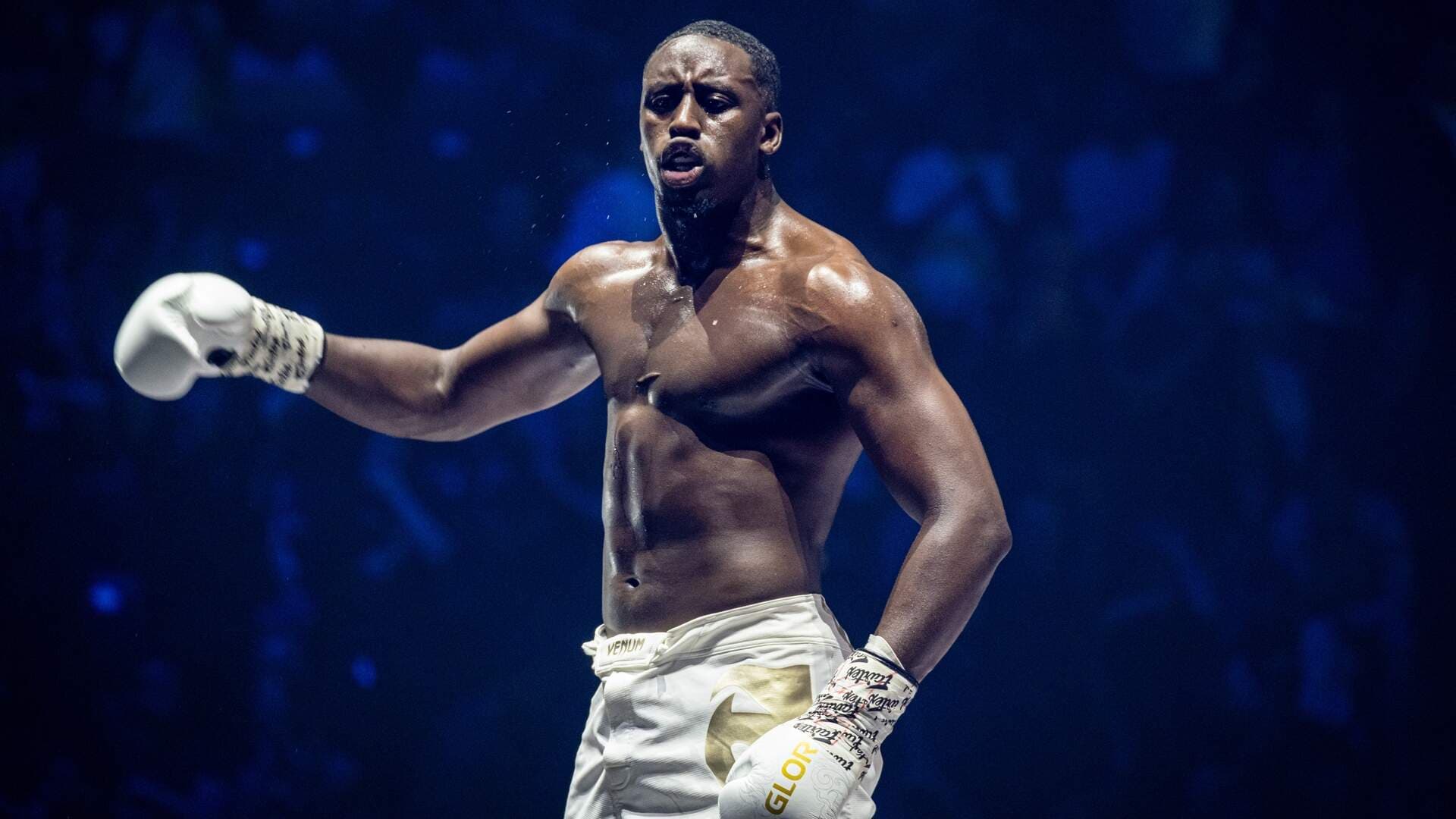
Mory Kromah Fighting Style: Range, Knees and KO Setups
 Lukas
LukasMory Kromah is a mobile, range-first heavyweight kickboxer whose most dangerous weapon is his knee attack. He uses straight punches, high kicks and movement to make opponents cross distance, then punishes their entries or compact guards with knees to the body and head. He can lead from the front, but he is not simply a pressure fighter: his speed, distance control and ability to change the rhythm of an exchange are what make the pressure effective.
That combination has taken Kromah from the light-heavyweight division to the GLORY heavyweight title. It has also produced two of his defining finishes: the jumping-knee knockout of Bahram Rajabzadeh and the flying-knee stoppage of Milos Cvjeticanin.
This breakdown examines how the system works, where it can be tested and what four important fights reveal about Kromah as a heavyweight.
Who is Mory Kromah?
Mory Kromah is a Guinean kickboxer and the reigning GLORY Heavyweight Champion. KickboxHub lists him at 194 cm and 102 kg and, at the time of publication, records a 17-1 professional record from the documented professional bouts stored in its database.
GLORY's own fighter profile uses a broader career total of 38 wins, 3 losses and 1 draw, while listing a 10-1 GLORY record. Those numbers answer different questions: KickboxHub calculates a record only from the documented professional bouts currently present in its database, whereas a promotion may publish a fighter's wider reported career total. The difference should not be “fixed” by manually changing one total to resemble the other.
| Detail | Current information | Scope/source |
|---|---|---|
| Nationality | Guinea | KickboxHub and GLORY |
| Height | 194 cm / 1.94 m | KickboxHub and GLORY |
| Listed weight | 102 kg on KickboxHub; 95 kg on GLORY's profile | Listings can reflect different dates or weigh-ins |
| KickboxHub record | 17-1 | Documented professional bouts stored by KickboxHub |
| GLORY record | 10-1 | GLORY promotional record |
| Status | GLORY Heavyweight Champion | GLORY |
| Next announced fight | Antonio Plazibat, December 12, 2026 | GLORY COLLISION 10 announcement |
For the latest bout-by-bout record, physical statistics and upcoming fight information, see the Mory Kromah fighter profile.
What is Mory Kromah's fighting style?
Kromah's style is built around an unusual heavyweight combination: a long frame, light movement and explosive attacks that can travel through the center of an opponent's guard. He is comfortable operating at the edge of punching range, where a small step can turn into a straight-punch combination, a high kick or a knee.
The key is not one spectacular technique. It is the number of threats an opponent must read from similar distances.
- Straight punches make a rival close the guard and give ground.
- High kicks force both hands upward and make upright movement dangerous.
- Body knees punish a tight shell and discourage opponents from simply walking forward.
- Jumping or flying knees can intercept an opponent who enters aggressively or rises into the attack.
- Footwork lets Kromah reset rather than remain in every exchange.
This is why “athletic heavyweight” is accurate but incomplete. His athleticism matters because it connects the phases of his offense: movement creates the entry, long attacks occupy the guard, and the knee becomes available when the opponent reacts.
1. Range and footwork come first
Kromah is often the quicker athlete in a heavyweight matchup. He uses that advantage to move in and out rather than standing at one fixed distance. Against larger opponents, the movement can force them to turn, reset and restart their offense. Against aggressive opponents, it gives him space to see the entry before deciding whether to retreat, punch through it or meet it with a knee.
That does not mean he spends every round circling on the outside. He can take the center and move forward, particularly when his opponent is giving up ground. The important distinction is that his pressure usually begins with range control rather than blind volume. He wants to make the other fighter react before committing to the most damaging attack.
An official GLORY fight preview described his offense as coming from different angles through straight punches, high kicks and knees. That is a useful summary of what the movement is designed to produce: attacks along the direct line, attacks around the guard and attacks up its middle.
2. Straight punches and high kicks stretch the defense
At 1.94 metres, Kromah can make opponents defend before they are close enough to start their preferred combinations. His straight punches are important even when they do not end the fight. They occupy the opponent's vision, establish the threat down the center and provide a relatively direct way to enter or exit.
The high kick asks a different question. A fighter who is concerned about Kromah's kick has to keep the guard responsible for the head and cannot lean casually into range. When the hands rise and the posture becomes more upright, the torso and the central lane can become more accessible to knees.
This layering is more important than treating each strike as an isolated weapon. Kromah can show one threat, read the defensive response and attack the space that response creates.
3. The knee is a system, not a trick
Kromah is best known for his knees, but the highlight finishes can obscure how many versions of the weapon he uses. He can attack the body at close range, drive a knee upward as an opponent advances, or launch a jumping or flying knee when the opponent's posture and momentum make the opening available.
The body knee has tactical value beyond immediate damage. It makes opponents pay for closing behind a high guard and can drain the energy needed to maintain heavyweight pressure. Once a rival begins anticipating the body attack or stands taller on entry, the head becomes a more realistic target.
His airborne knees are therefore not random acts of athleticism. They sit at the end of a decision tree created by range, straight attacks, kicks and the opponent's own forward movement. The precise setup changes from fight to fight, but the recurring idea is the same: make the center line difficult to cross safely.
Kromah's knockout of Rajabzadeh was named GLORY's 2025 Knockout of the Year. His first heavyweight title defense against Cvjeticanin then ended with another flying knee in round three. Producing that kind of finish against different opponents is evidence of a repeatable weapon, not a single lucky moment.
4. He can counter pressure or become the pressure fighter
One reason Kromah is difficult to reduce to a single label is that his role changes with the matchup.
Against a charging opponent, his length and knees can turn the opponent's momentum into an opportunity. Against a bigger but slower heavyweight, he can stay lighter on his feet, score from outside and make the opponent repeatedly rebuild the attack. When a rival retreats or covers, Kromah can step forward and use long punches and knees to keep that rival working.
The common thread is adaptability. He is at his best when he controls where the exchange begins and can choose whether it continues. He is less comfortable when an opponent removes that choice by keeping him in prolonged, physical exchanges.
5. What the GLORY statistics show—and what they do not
GLORY's fighter profile lists Kromah at 6.29 strikes landed per minute, 6.7 strikes absorbed per minute and 56.55% striking accuracy. It also lists a 5:1 knockdown ratio and an average fight time of 6:43.
Those figures support two observations.
First, Kromah is not a low-contact outfighter who wins only by avoiding exchanges. His bouts can contain meaningful two-way activity. Second, his accuracy and knockdown ratio show that his offense is not merely busy: it produces damaging outcomes.
The absorption figure also provides a necessary warning. Kromah can be hit, and his speed does not make him defensively untouchable. Raw promotional statistics cannot explain strike quality, opponent level or the context of each exchange, but they do caution against describing him as a fighter who controls every contest without taking risks.
Four fights that explain Mory Kromah's style
No single highlight fully explains a fighter. These four bouts show different parts of Kromah's game: composure in chaos, disciplined work against a late replacement, movement against a much larger heavyweight and a repeatable championship-level finishing weapon.
1. Bahram Rajabzadeh: composure and the jumping knee
Kromah's GLORY 100 fight with Bahram Rajabzadeh is the clearest example of why an opponent cannot attack him recklessly.
Rajabzadeh brought immediate aggression, using wild punching entries and jumping attacks to create a chaotic fight. The bout also included illegal strikes by Rajabzadeh and a point deduction. That context matters: Kromah had to remain tactically functional in a short, heated contest rather than a clean technical match at his preferred rhythm.
After the restart, Kromah found the decisive answer at close range. He scored a knockdown with a knee and then finished the fight with a jumping knee as Rajabzadeh committed to his own attack. The sequence demonstrated three qualities at once:
- Kromah stayed composed after the fouls and interruption.
- He recognized that Rajabzadeh's forward commitment exposed the central lane.
- He had the timing and athleticism to turn that opening into an immediate finish.
The lesson is not simply that Kromah can jump high. It is that aggressive entries against him carry an unusual cost. A conventional high guard may protect against punches while leaving the opponent's posture vulnerable to a knee travelling up the middle.
GLORY selected the finish as its 2025 Knockout of the Year, and the promotion has published the full Kromah–Rajabzadeh fight.
2. Michael Boapeah: disciplined work when the matchup changes
Michael Boapeah entered GLORY 105 as a late replacement for Antonio Plazibat. That created a different problem from the Rajabzadeh fight. Kromah was not preparing for exactly the same body type, rhythm or tactical habits he had expected, while Boapeah was stepping up from the middleweight/light-heavyweight range.
Kromah won a unanimous decision, with one judge scoring it 30-27 and four scoring it 29-28. The result is useful because it shows that his game does not depend on forcing a spectacular finish. Faced with an opponent change, he could bank rounds and progress in a one-night heavyweight tournament without abandoning structure in search of a highlight.
This fight also helps separate Kromah's reputation from the reality of his style. The knees are the headline, but tournament success requires decisions about energy, risk and control. Not every opening should produce a flying attack, especially when another bout may follow later that night.
GLORY's late-replacement announcement supplies the matchup context, while the promotion's GLORY 105 results record the decision and scorecards.
3. Tariq Osaro: speed and activity against a bigger heavyweight
Tariq Osaro presented the kind of physical test that follows a fighter moving up from light heavyweight. Kromah could not rely on being the naturally bigger man. Instead, he used mobility and activity to make the larger heavyweight work.
Contemporary reporting described Kromah staying on his toes and picking Osaro apart from the outside. As the fight became more tiring, Kromah's activity helped him continue scoring in a grinding contest. He earned another unanimous decision, with two 30-27 cards and three 29-28 cards.
The performance showed why his footwork is more than decoration. Against a larger opponent, remaining mobile can reduce the number of settled exchanges in which size and physical pressure have maximum value. Kromah can score, move and force the heavier fighter to spend energy closing the same distance again.
It also exposed a possible pressure point in his game. The fight became tiring and untidy rather than effortless. A large opponent who can consistently cut off exits, attack the body and keep Kromah working may reduce the explosiveness that makes his knees so dangerous. Osaro did not win, but the matchup illustrated the type of physical problem future challengers will try to reproduce.
The official GLORY 105 results contain the scorecards. Beyond Kickboxing's event report supplies additional tactical context.
4. Milos Cvjeticanin: the signature weapon works at championship level
Kromah and Milos Cvjeticanin already had history before their 2026 title fight. Kromah had beaten Cvjeticanin by decision at COLLISION 7 in 2024. They were then supposed to meet in the final of the GLORY 105 Last Heavyweight Standing tournament, but Cvjeticanin could not compete because of a toe injury and Kromah was declared the tournament winner.
That unfinished business made the rematch important. Kromah needed to validate his status against the opponent he had been expected to face in the tournament final.
At COLLISION 9, he did so decisively. Kromah stopped Cvjeticanin with a flying knee at 1:55 of round three to retain the heavyweight title. The finish mattered beyond the result:
- it came after the opponent had already shared rounds with him before, both in the first meeting and in the title fight;
- it reproduced Kromah's signature weapon under championship pressure; and
- it showed that the Rajabzadeh knockout was not an isolated highlight against a uniquely reckless opponent.
The tactical lesson is that surviving Kromah's early speed does not remove the knee threat. It remains dangerous after both fighters have accumulated reads and fatigue. An opponent must manage posture and distance for the entire fight, not merely avoid one explosive opening exchange.
GLORY's COLLISION 9 results record the third-round finish. The promotion's COLLISION 9 announcement explains the earlier decision and the rivalry's history.
Mory Kromah's main strengths
| Strength | Why it matters |
|---|---|
| Heavyweight size with lighter-division movement | He can make larger opponents reset and can attack before their feet are settled. |
| Multiple attacks from long and middle range | Straight punches, high kicks and knees require different defensive responses. |
| Elite knee threat | Body, jumping and flying knees punish both compact guards and aggressive entries. |
| Adaptability | He has won through explosive knockouts, controlled decisions and a demanding tournament format. |
| Composure | The Rajabzadeh fight showed that he can recover tactically after disorder and fouls. |
| Proven finishing threat late in a fight | The Cvjeticanin title defense ended by flying knee in round three. |
Where can Mory Kromah be tested?
These are questions opponents can try to ask rather than proven fatal flaws.
Sustained physical pressure
Kromah is most dangerous when he can control the beginning and end of an exchange. A heavyweight who cuts off the ring instead of following him may force longer periods of defensive work and reduce the clean space needed for explosive entries.
Body work and energy management
Mobile footwork and airborne knees require energy. A challenger who safely attacks the body and makes Kromah carry weight in close exchanges could test whether the same speed remains available late.
Two-way exchanges
GLORY's own profile shows that Kromah absorbs significant volume as well as landing it. Opponents will look for moments when he remains in range after attacking or when his offensive confidence makes the exchange more open than necessary.
Patient opponents who do not overreact
The system becomes especially dangerous when an opponent charges, shells tightly or gives a large defensive reaction. A patient fighter who varies entries, feints without committing and refuses to present the same posture may make the decisive knee harder to time.
None of these approaches is simple. Closing distance invites the knee, body attacks require entering range, and passivity allows Kromah to score from outside. That tactical conflict is precisely why he is champion.
What does the Antonio Plazibat fight test?
GLORY has announced Kromah's next heavyweight title defense against Antonio Plazibat for December 12, 2026, at COLLISION 10 in Arnhem.
The matchup should test the boundary between Kromah's mobility and heavyweight pressure. Kromah will want space to change angles, establish straight attacks and make Plazibat's entries predictable. Plazibat's route is likely to involve taking that space away, making the champion work physically and preventing clean resets.
For Kromah, the strategic danger would be allowing the fight to become a static exchange in which movement no longer creates uncertainty. For Plazibat, the danger is overcommitting while crossing range and giving the champion the central lane for a knee.
This is a style question rather than a prediction. Form, health and the final bout circumstances can change before fight night. The confirmed details are available in GLORY's COLLISION 10 announcement.
Why do Mory Kromah's record totals differ between websites?
Kickboxing record totals often differ because databases and promotions use different scopes and evidence standards.
KickboxHub does not manually type a headline win-loss total into a fighter's profile. It calculates the record from professional bouts stored in the database. The aim is to document every professional bout, but some organizations do not publish complete results, and older regional records may be unavailable. A missing bout therefore remains missing until it can be documented; it is not replaced by an unsupported manual adjustment.
GLORY's profile currently advertises a wider 38-3-1 career record and separately lists Kromah as 10-1 in GLORY. KickboxHub currently shows 17-1 from its stored professional bouts. Neither number should be presented without its scope.
For a fuller explanation, read Why Kickboxing Records Disagree: Professional vs Amateur Records Explained.
Key takeaways
- Mory Kromah is a mobile, range-first heavyweight rather than a one-dimensional pressure fighter.
- Straight punches and high kicks stretch the defense; knees punish the reactions they create.
- The jumping and flying knees are repeatable parts of his system, demonstrated against Rajabzadeh and Cvjeticanin.
- Decisions over Boapeah and Osaro show that he can adapt when a knockout is unavailable or unnecessary.
- His activity creates two-way exchanges, so sustained pressure, body work and disciplined entries are the most interesting tests for future opponents.
- Record totals should always be read with their source and scope: KickboxHub's total is generated from stored documented professional bouts.
Frequently asked questions
What fighting style does Mory Kromah use?
Mory Kromah is a mobile, range-first kickboxer. He uses straight punches, high kicks and footwork to manage distance, then attacks the body or head with knees when opponents close range or tighten their guard.
What is Mory Kromah's signature move?
His signature weapon is the knee, particularly jumping and flying knees to the head. He knocked out Bahram Rajabzadeh with a jumping knee and stopped Milos Cvjeticanin with a flying knee.
How tall is Mory Kromah?
Kromah is listed at 194 cm, or approximately 6 feet 4 inches.
Is Mory Kromah the GLORY Heavyweight Champion?
Yes. Kromah won the Last Heavyweight Standing tournament finals in February 2026 and retained the title against Milos Cvjeticanin at COLLISION 9 in June 2026.
When is Mory Kromah's next fight?
GLORY has announced that Kromah will defend the heavyweight title against Antonio Plazibat at COLLISION 10 on December 12, 2026. Fight schedules can change, so verify the current listing on the Mory Kromah profile or the official event page.
What is Mory Kromah's record?
At publication, KickboxHub calculates a 17-1 record from the documented professional bouts stored in its database. GLORY advertises a broader 38-3-1 career total and a 10-1 promotional record. The difference reflects database coverage and record scope, so each figure should be attributed rather than blended.
Mentioned Fighters

Related Events

Comments (0)
Sign in to leave a comment.
No comments yet. Be the first!