
The Sergej Maslobojev GLORY Scandal: Why Only 12 Months for Stanozolol?
 Lukas
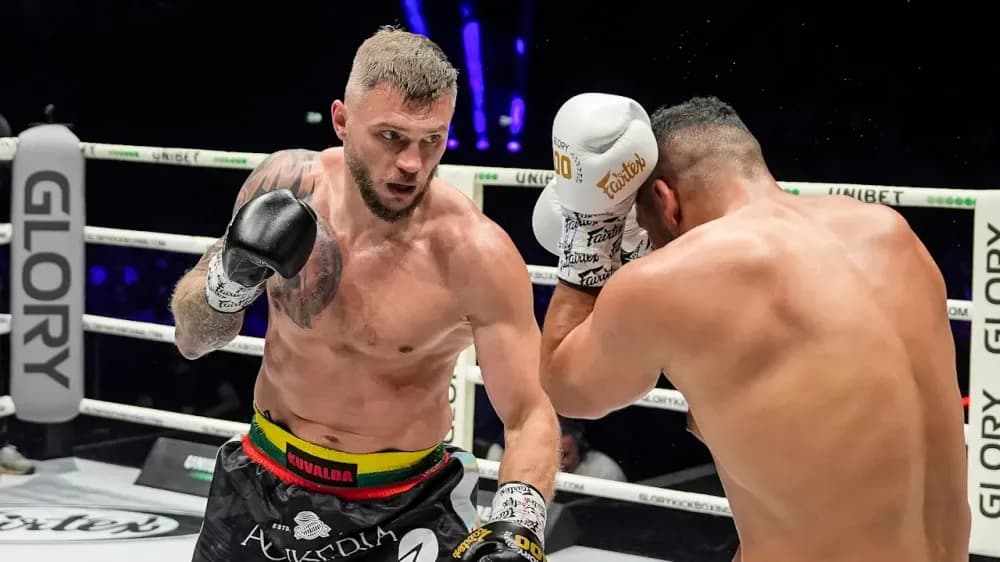
LukasWhen GLORY Kickboxing officially announced the suspension of Light Heavyweight star Sergej Maslobojev following his dominant performance against Tarik Khbabez at GLORY 100, the combat sports community was left with more questions than answers.
Maslobojev’s out-of-competition and in-competition samples tested positive for a metabolite of stanozolol—a strict Category S1 anabolic agent on the WADA Prohibited List.
But while standard WADA protocols usually dictate a devastating 24 to 48-month suspension for anabolic steroids, Maslobojev walked away with just 12 months. How did a positive steroid test result in such a lenient ruling?
The Independent Lab Defense
From the moment the initial findings were revealed, Maslobojev vehemently denied knowingly ingesting any prohibited substances. Refusing to accept the "steroid cheat" label, the Lithuanian fighter went on a massive offensive to clear his name.
He invested thousands of euros of his own money into independent testing. He sent hair and nail samples to top-tier laboratories in London, alongside every supplement and medication he was taking at the time. According to Maslobojev, these long-term biological markers all returned completely negative, supporting his claim that he was not cycling stanozolol.
The "Freezer" Rumor: Was the Sample Mishandled?
While GLORY officially cited Maslobojev's "cooperation during the investigation" as the reason for the reduced 12-month ban, a persistent rumor has gripped the kickboxing underground.
Protocol dictates that biological samples must be handled under the strictest chain of custody. However, rumors have circulated within the Baltic kickboxing community that the container holding Maslobojev's sample may have been improperly handled—allegedly being taken in and out of a freezer multiple times before analysis, rather than the legally required single-thaw process.
If a sample's temperature stability is compromised, the scientific validity of the test can be thrown out entirely in arbitration. Did GLORY and the Anti-Doping Committee offer a reduced plea deal to avoid a messy, public legal battle over mishandled evidence?
The Unbeatable Aura: Why a Suspension Was the Only Way
To understand why the conspiracy theories hold so much weight, you have to look at Maslobojev's recent track record. Prior to this suspension, the man possessed an aura of invincibility. His only two recent blemishes inside the GLORY ring weren't the result of being out-struck—they were highly controversial, freak doctor stoppages.
He lost his Light Heavyweight title to Donegi Abena at GLORY 83 when the ringside physician waved off the fight due to a cut on Maslobojev's shin, despite the champion being furious and visibly ready to continue. Then, at the 2024 Light Heavyweight Grand Prix, an accidental clash of heads with Bahram Rajabzadeh resulted in a severe gash on Maslobojev's chin and lip, forcing another abrupt medical exit.
Nobody was cleanly knocking him out or outpointing him. To many of his loyal fans, the 12-month ban feels less like a valid WADA sanction and more like a bureaucratic weapon used to sideline an "unbeatable" problem child.
The Geopolitical Headache: Was the Suspension Convenient?
There is another, much heavier layer to this story: politics.
Maslobojev has been one of the most outspoken athletes in combat sports regarding the Russian invasion of Ukraine. In a 2022 interview, he drew a hard line in the sand, stating unequivocally: "I know for sure that I would not share the ring with a person who openly supports Russia's actions on the territory of Ukraine, or who represents the country of the aggressor..."
While GLORY initially supported this stance, the global kickboxing landscape eventually shifted. As new Russian prospects and neutral-flag athletes entered the GLORY rankings, Maslobojev’s absolute refusal to fight them created a massive matchmaking nightmare. You cannot have a champion or top contender who refuses to fight the division's rising stars.
This geopolitical friction has led many to wonder: Was GLORY actually relieved when the stanozolol anomaly occurred? A 12-month suspension effectively benched their most politically vocal fighter, cleared the Light Heavyweight title picture, and allowed GLORY to book their neutral athletes without international controversy.
GLORY Double Standard: The Tomas Mozny Precedent
What makes the 12-month ruling so highly suspicious isn't just the WADA protocol - it is GLORY's own internal precedent.
Just two months prior to Maslobojev's test, GLORY 99 took place. Following that event, Heavyweight Tomas Mozny tested positive for metandione, which, exactly like Maslobojev's stanozolol, is classified as an Anabolic Agent.
GLORY brought the hammer down on Mozny, slapping him with a devastating 24-month suspension.
How does one fighter get two years for an anabolic agent, while a former champion gets exactly half that time for the exact same category of substance just weeks later? GLORY claims "cooperation" led to the reduction, but to the kickboxing fanbase, it looks like a glaring double standard. It begs the question: Does GLORY negotiate sanctions based on the fighter's star power, or worse, their political convenience to the promotion?
The Collision 9 Wildcard: Will GLORY Bend Their Own Rules?
This brings us to the most burning question in the kickboxing world today: Will Sergej Maslobojev return for the 2026 GLORY Light Heavyweight Grand Prix?
On April 25, 2026, GLORY 107 concluded with six fighters—including Luis Tavares and Ștefan Lătescu—securing their spots in the 8-man Grand Prix scheduled for GLORY Collision 9 on June 13, 2026. That leaves exactly two unassigned "Wildcard" slots in the bracket.
Here is the catch: Maslobojev's 12-month suspension was backdated to his June 14, 2025 test date. This means his ban technically expires exactly one day after the Collision 9 tournament.
To let him fill that wildcard spot, GLORY would have to bend its own timeline and break its own rules. But given how the initial 12-month reduction was mysteriously handled behind closed doors, do they strictly follow the rules at all? If the promotion wants a massive ratings boost, overlooking a 24-hour technicality seems entirely possible.
The Aftermath
If GLORY issues him the wildcard by bending the dates, it will be one of the most highly anticipated—and controversial—comebacks in kickboxing history. But if they leave him out of the bracket, it will only pour gasoline on the rumors that GLORY prefers to keep their outspoken former champion out of the political spotlight.
The kickboxing world is watching, and the clock is ticking toward June 13.
Mentioned Fighters



Related Events

Comments (0)
Sign in to leave a comment.
No comments yet. Be the first!