
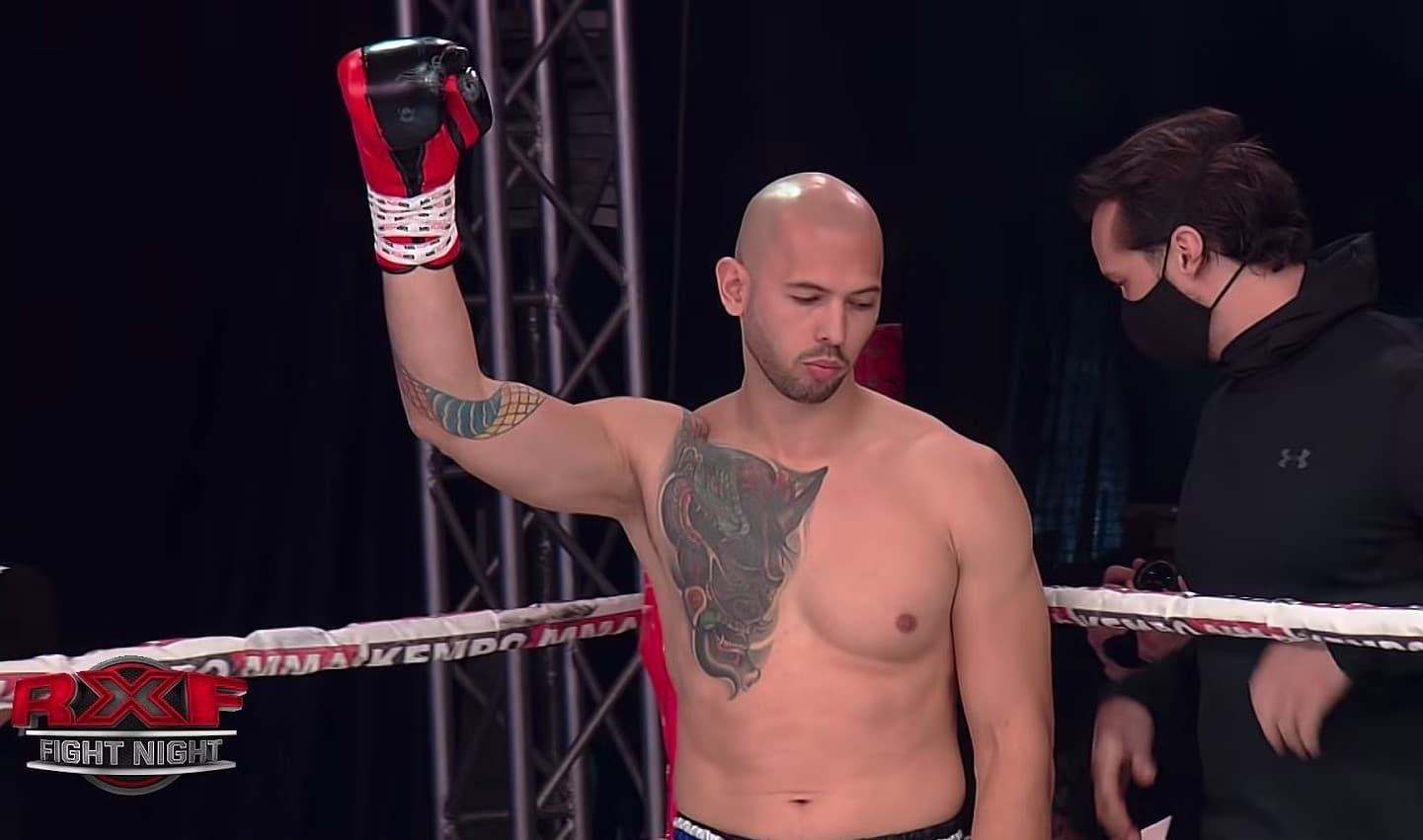
Andrew Tate Kickboxing Record: Career, Titles and Key Fights
 Lukas
LukasAndrew Tate was a professional full-contact and K-1-rules kickboxer who won recognized British and world titles. His documented achievements include an IKF British title, ISKA world-title victories over Jean-Luc Benoit and Vincent Petitjean, and the Enfusion 90 kg title won against Wendell Roche.
The difficult part is his record. Different sources publish totals ranging from KickboxHub's current 5-2 database record to the 76-9-1 figure claimed by Tate's own website. Those numbers are not interchangeable. Some are snapshots, some cover one promotion, some are bout-by-bout reconstructions, and some are self-reported career totals.
This guide separates what can be documented from what is claimed, then traces the fights that best explain Tate's level and achievements.
What was Andrew Tate's kickboxing record?
There is no single public total that can currently be reproduced from one complete, authoritative bout ledger.
| Published record | What it represents |
|---|---|
| 5-2 on KickboxHub | Seven completed professional bouts currently stored in the KickboxHub database; it is not presented as Tate's complete career record |
| 4-2 on Enfusion's official profile | Six fights listed by Enfusion, all within that promotion's own record page |
| 13-2 on an IKF historical page | A career snapshot published when Tate held the IKF British title in 2009 |
| 23-8 in a specialist reconstruction | Thirty-one bouts assembled individually by MuayThaiRecords from available results |
| 76-9-1, 32 knockouts on Tate's website | Tate's self-published overall career claim; the site does not provide a complete opponent-by-opponent ledger that reproduces it |
For that reason, the most accurate short answer is: Andrew Tate's full career total is disputed, but his title wins and a substantial part of his professional fight history are independently documentable.
See the Andrew Tate fighter profile for the professional bouts currently stored by KickboxHub. The total there is calculated only from those stored results; it is never manually changed to match an outside headline record.
Why do Andrew Tate's record totals disagree?
Kickboxing does not have one universal record keeper. A fighter can appear in national full-contact events, international promotions, tournaments and isolated shows whose records were never collected in the same system. Older events are especially difficult to reconstruct when official result pages disappear or never existed online.
The sources also answer different questions. Enfusion's 4-2 figure is a promotional record. The IKF's 13-2 was a dated snapshot rather than a final career total. KickboxHub's number covers only verified professional bouts already entered in its database. Tate's 76-9-1 is a claim about his entire career, including many fights not itemized on that page.
This does not prove that the largest total is false. It means the public evidence currently available does not let a reader independently rebuild it bout by bout. The distinction matters: a transparent partial record is more useful than a complete-looking number whose underlying fights cannot be checked.
For a fuller explanation of this problem across the sport, read Why kickboxing records disagree: professional vs amateur records explained.
Early career and the first domestic titles
Tate began training in Luton, England, during the mid-2000s. His early documented career took place mainly in British full-contact kickboxing, a rule set built around punches and kicks above the waist rather than the broader clinch-and-knee game associated with Muay Thai.
The first important title result came against Paul Randall in April 2009, when Tate won the ISKA English Full Contact Cruiserweight title. Later that year he knocked out Daniel Hughes in Bristol to win the IKF Pro Full Contact British Light Cruiserweight title.
The IKF's historical champions page identifies him as Andrew “King Cobra” Tate of Luton, lists a 13-2 record at the time and records the September 26, 2009 knockout of Hughes. It also says the title was retired on January 8, 2018 because Tate had retired from competition.
These domestic titles established him as more than a novice building a padded record. They also set up the move from British competition into international title fights.
Jean-Luc Benoit and Tate's first ISKA world title
Jean-Luc Benoit was central to Tate's rise. Benoit won their first meeting by decision in March 2011. Tate then received an immediate rematch in June and stopped Benoit in the eighth round to win the ISKA World Full Contact Light Heavyweight title.
The rivalry matters for two reasons. First, it produced a clear world-title victory under an established sanctioning body. Second, it showed that Tate could reverse a recent loss rather than avoiding the opponent who had beaten him.
ISKA's own 2011 awards report supports the importance of the series: Tate vs Benoit was nominated for Fight of the Year and Tate received the Male Kickboxing Fighter of the Year award.
This is one of the strongest answers to the question “Was Andrew Tate really a world champion?” Whatever disagreement exists over his total record, the Benoit rematch was a documented ISKA world-title fight that Tate won by stoppage.
Setbacks against Vincent Petitjean and Sahak Parparyan
Tate's progress was not uninterrupted. Vincent Petitjean beat him by decision in a 2011 full-contact title fight. Tate later avenged that loss, but the first result belongs in any balanced account of his career.
In May 2012 Tate challenged Sahak Parparyan for the It's Showtime 85MAX world title. Parparyan won by decision. It's Showtime was one of the era's significant international kickboxing promotions, and Parparyan was an established top-level opponent. The loss is evidence that Tate competed at a serious level; it is also evidence that he did not win every major title opportunity.
This distinction helps place his career accurately. Tate was a legitimate international contender and champion, but he did not establish a long reign over the strongest global division or win a K-1 World Grand Prix.
The 2012 Enfusion tournament
Tate entered Enfusion's 2012 tournament and advanced through the competition before meeting Franci Grajš in the final. Grajš stopped him in the first round.
Tournament formats create a different test from a one-off title fight. A fighter has to manage preparation, travel and multiple opponents inside the event structure. Reaching the final was meaningful; losing there also became one of the clearest stoppage defeats of Tate's documented career.
The result is sometimes omitted from promotional summaries that focus only on championships. It should not be. Tate's wins, losses and level are easier to understand when both title victories and failed runs are preserved.
The Petitjean rematch and a second ISKA world title
Tate fought Vincent Petitjean again on March 9, 2013. This time Tate won by split decision in France to take the ISKA World Full Contact Light Cruiserweight title at 84.6 kg.
A contemporary Power Trophy preview described the contest as an ISKA world-title fight scheduled for twelve two-minute rounds. The victory gave Tate another independently traceable world championship and avenged a previous defeat, much as the Benoit rematch had done.
Tate later defended the ISKA belt against Cyril Vetter in March 2014, winning by knockout. A title defense is significant, but it should not automatically be presented as a completely separate world championship. This is one reason “four-time world champion” can be ambiguous: the number changes depending on whether a new sanctioning-body title, a new weight class, a reign and a defense are counted in the same way.
Building an Enfusion run
Tate also assembled a run in Enfusion. The promotion's official Andrew Tate profile lists wins over David Radeff, Marino Schouten, Laszlo Szabo and Wendell Roche, plus losses to Mirko Cingel and Ibrahim El Boustati.
One additional result requires care. Enfusion published footage of Tate vs Marlon Hunt from Enfusion 6, and contemporary reporting says Tate won by unanimous decision on June 29, 2013. That bout is currently present on KickboxHub but still marked Scheduled. It therefore does not yet contribute to the profile's calculated record and should be corrected at the bout level rather than patched into the W-L total.
This example shows why record auditing is slow. Even when a fight is known to have happened, its opponent identity, date, rules, round count and result still need to be reconciled before a database can responsibly count it.
The Mirko Cingel loss and Wendell Roche title win
Mirko Cingel beat Tate by decision at Enfusion 17 in April 2014. Two months later Tate returned at Enfusion 19 to face Wendell Roche for the promotion's 90 kg world title.
Tate stopped Roche in the second round. The result is one of the strongest achievements on his résumé: Roche was an experienced opponent, the fight was for an identifiable Enfusion championship, and the finish appears in Enfusion's own record.
The sequence also illustrates Tate's resilience. He did not receive the Enfusion title on the back of an unbeaten promotional run; he recovered quickly from the Cingel loss and won the next title fight by stoppage.
The final years of his main career
Tate fought Liang Ling at a K-1-branded China vs USA event in January 2015 and won by unanimous decision. He also fought Jean-Luc Benoit again in March 2015, winning their third documented meeting by decision.
His last major Enfusion appearance came against Ibrahim El Boustati at Enfusion 44 on December 3, 2016. El Boustati won by first-round stoppage. Enfusion's official El Boustati profile records the victory, and Enfusion has published the full fight.
That bout is often described as Tate's last fight because it ended the main, title-level phase of his career. It was not his final documented appearance, however.
Did Andrew Tate fight again in 2020?
Yes. The bout-by-bout reconstruction published by MuayThaiRecords, supported by publicly available fight footage, documents a short return in Romania in 2020, with victories over Miralem Ahmeti, Iulian Strugariu and Cosmin Lingurar.
Those comeback bouts mean “retired in 2016” needs qualification. Tate stepped away after the El Boustati loss and his IKF title was formally retired in 2018, but he later returned for three fights. No comparable sustained title run followed the comeback.
At the time of publication, there is no verified announcement of another professional kickboxing bout. Rumors or social-media callouts should not be treated as scheduled fights without an event, opponent and promoter confirmation.
Which kickboxing titles did Andrew Tate win?
The clearest documented championship results are:
| Year | Title | Opponent | Result |
|---|---|---|---|
| 2009 | ISKA English Full Contact Cruiserweight | Paul Randall | Tate win by stoppage |
| 2009 | IKF Pro Full Contact British Light Cruiserweight | Daniel Hughes | Tate win by knockout |
| 2011 | ISKA World Full Contact Light Heavyweight | Jean-Luc Benoit | Tate win by eighth-round knockout |
| 2013 | ISKA World Full Contact Light Cruiserweight | Vincent Petitjean | Tate win by split decision |
| 2014 | ISKA world-title defense | Cyril Vetter | Tate win by knockout |
| 2014 | Enfusion 90 kg World Championship | Wendell Roche | Tate win by second-round TKO |
Tate's official biography describes him as a four-time world champion—three ISKA titles and one Enfusion title. That is his own presentation of the career. A more transparent way to assess the claim is to name the sanctioning body, weight class, opponent and result, as the table does.
The table supports the central conclusion: Tate did win recognized world-level kickboxing titles. The exact number attached to “world champion” depends on how separate reigns, divisions and defenses are counted.
Who were Andrew Tate's most important opponents?
Jean-Luc Benoit
Benoit beat Tate in their first fight, lost the ISKA world-title rematch by knockout and later lost their third meeting by decision. The rivalry demonstrates both Tate's vulnerability and his ability to adjust across repeat matchups.
Sahak Parparyan
Parparyan was among the most accomplished opponents Tate faced. Their It's Showtime title fight connects Tate to a strong international circuit, while the decision loss sets a reasonable ceiling on exaggerated claims about complete dominance.
Vincent Petitjean
Petitjean won the first meeting and lost the rematch for an ISKA world title. Like Benoit, he is important because the rivalry contains a loss, an adjustment and a championship result.
Franci Grajš
Grajš stopped Tate in the 2012 Enfusion tournament final. It was a high-value tournament opportunity and one of Tate's most consequential defeats.
Mirko Cingel
Cingel handed Tate a decision loss in 2014, shortly before Tate rebounded to win the Enfusion title.
Wendell Roche
Roche was the opponent for Tate's Enfusion championship victory. Tate's second-round stoppage is one of the defining wins of his career.
Ibrahim El Boustati
El Boustati stopped Tate in 2016 in the final major-promotional fight of Tate's main career. The result is documented by Enfusion itself.
How good was Andrew Tate as a kickboxer?
Andrew Tate was an accomplished international-level kickboxer. Winning ISKA and Enfusion world titles, defending an ISKA belt, reaching an Enfusion tournament final and challenging for an It's Showtime championship require far more than local-level ability.
At the same time, the evidence does not support treating him as the dominant kickboxer of his era. He did not win the It's Showtime belt, did not win the Enfusion tournament and did not build a long championship run in a leading global league comparable with the K-1 World Grand Prix or modern GLORY. Several strong opponents beat him.
Both facts can be true: his career was legitimate and successful, and some descriptions of it are inflated by unclear record totals or championship counting.
What was Andrew Tate's fighting style?
Tate's base was full-contact kickboxing. He fought from an orthodox stance and used his height, straight punches and long kicks to operate at range. His experience under different rule sets required adjustments: full-contact competition emphasizes above-the-waist kicking, while Enfusion and K-1-style bouts allow a broader mix of low kicks and knees.
His best-known results show more than one route to victory. He could accumulate rounds to win decisions, as he did in several later fights, but he also recorded meaningful stoppages over Benoit, Vetter and Roche. The losses reveal the trade-off in his approach: opponents who controlled the exchanges, disrupted his preferred range or forced a higher pace could take decisions or create stoppage opportunities.
That is a more defensible description than building a technical profile from highlight clips alone. Complete footage is available for only part of the career, and the rules changed between events.
Andrew Tate kickboxing career: key takeaways
- Tate was a genuine professional kickboxer and a recognized ISKA and Enfusion world champion.
- His most defensible achievements are individual, traceable title wins—not an unexplained headline record.
- The 76-9-1 figure comes from Tate's own website and cannot currently be reproduced from a public bout-by-bout ledger.
- KickboxHub's smaller record is intentionally limited to professional bouts stored with results; it is not a claim that only seven career fights occurred.
- Important losses to Benoit, Petitjean, Parparyan, Grajš, Cingel and El Boustati are part of the record and help establish the level of opposition.
- The 2016 El Boustati loss ended his main title-era run, but three documented 2020 comeback wins mean it was not his final fight.
Frequently asked questions
What is Andrew Tate's kickboxing record?
There is no universally verified final total. KickboxHub currently calculates 5-2 from the completed professional bouts stored in its database, a specialist reconstruction lists 23-8, and Tate's own website claims 76-9-1 with 32 knockouts. The totals cover different evidence and scopes.
Was Andrew Tate really a kickboxing world champion?
Yes. He won documented ISKA world-title fights against Jean-Luc Benoit and Vincent Petitjean, defended an ISKA belt against Cyril Vetter, and stopped Wendell Roche to win the Enfusion 90 kg world title.
How many world titles did Andrew Tate win?
Tate's own site calls him a four-time world champion. Because championship counts can mix different divisions, reigns and defenses, the most reliable approach is to examine each title fight individually. His ISKA and Enfusion world-title wins are documented.
Who beat Andrew Tate in kickboxing?
Documented losses include Scott Gibson, Luke Sines, Jean-Luc Benoit, Vincent Petitjean, Sahak Parparyan, Franci Grajš, Mirko Cingel and Ibrahim El Boustati. The exact list depends on which reconstruction and career scope is used.
What was Andrew Tate's last kickboxing fight?
The El Boustati fight in December 2016 was his last major Enfusion appearance, but Tate returned for three documented bouts in Romania in 2020. The most recent widely documented result is a win over Cosmin Lingurar in December 2020.
When did Andrew Tate retire from kickboxing?
He stepped away from regular competition after 2016, and the IKF formally retired his British title in January 2018 because he had retired. His three-fight return in 2020 makes retirement a period rather than one absolute final date.
What weight did Andrew Tate fight at?
Tate competed across nearby light-heavyweight and cruiserweight limits, including ISKA title fights around 81.5 kg and 84.6 kg and an Enfusion championship at 90 kg. Divisional names vary between sanctioning bodies.
What was Andrew Tate's kickboxing nickname?
He competed as Andrew “King Cobra” Tate. The nickname appears on the IKF's historical champions page.
Mentioned Fighters

Comments (0)
Sign in to leave a comment.
No comments yet. Be the first!